


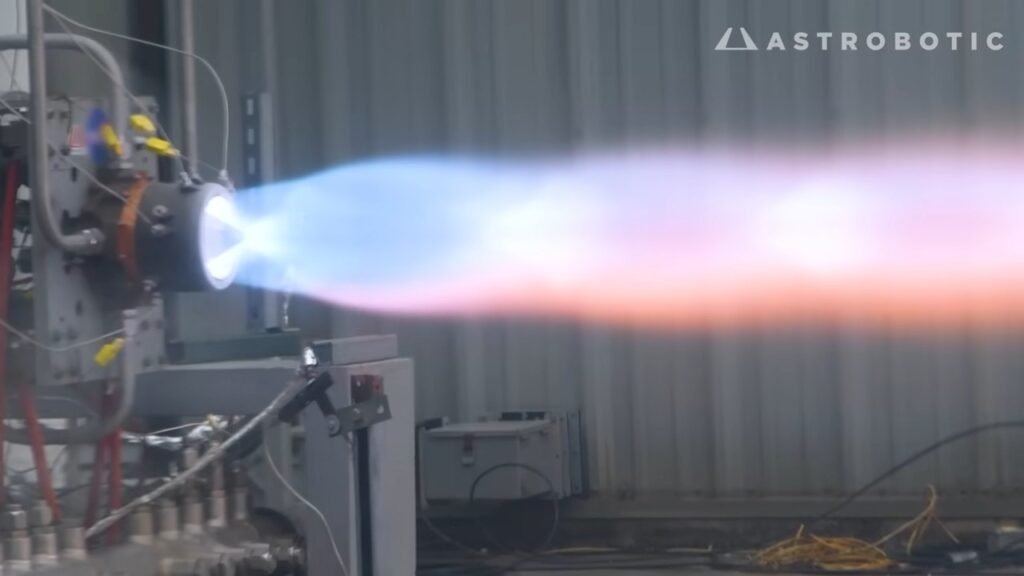
Astrobotic Detonation Engine Test Marks Major Leap in Rocket Propulsion Technology
Astrobotic detonation engine test has officially put a spotlight on one of the most exciting frontiers in space propulsion technology. The Pittsburgh-based space startup has successfully fired up its rotating detonation rocket engine, or RDRE, for the very first time, generating an impressive 4,000 pounds of thrust in a series of hot-fire trials. This breakthrough demonstration could pave the way for a fundamentally new class of rocket engines that may one day power missions to the Moon, Mars, and beyond.
While the test took place at NASA’s Marshall Space Flight Center in Alabama, the implications stretch far beyond the testing facility. Let’s explore what just happened, why it matters, and how this technology could reshape the future of space exploration.
The Test Results That Have Engineers Excited
Astrobotic conducted a series of eight hot-fire tests on two engine prototypes, achieving results that have surprised even the engineers working on the project. Each engine generated more than 4,000 pounds of thrust, equivalent to roughly 1,800 kilograms, with a combined runtime of 470 seconds across all the tests.
One particularly notable single burn lasted a full 300 seconds, demonstrating that the engine can sustain prolonged operation without breaking down. For an experimental propulsion system, that kind of endurance is genuinely impressive and signals that the technology is moving from theoretical promise to practical reality.
What’s even more remarkable is that the engine performed flawlessly on its very first test attempt — a rare occurrence in the world of rocket development, where early failures and unexpected anomalies are typically par for the course.
Understanding How RDRE Technology Works
To appreciate why this test is such a big deal, it helps to understand what makes a rotating detonation rocket engine different from traditional rocket propulsion.
Conventional rocket engines generate thrust through controlled combustion. Fuel and oxidizer mix and burn in a combustion chamber, with the resulting exhaust gases expelled through a nozzle to push the rocket forward. This process has powered spaceflight for decades and continues to dominate the industry.
RDREs work on a fundamentally different principle. Instead of relying on standard combustion, they use a series of detonations that travel around a circular channel inside the engine. Highly pressurized propellant combines with an oxidizer inside the combustion chamber, and the resulting shockwaves drive the engine forward.
The key difference comes down to efficiency. Detonations release energy much more rapidly and intensely than traditional combustion. This allows RDREs to produce more thrust while using less fuel, all in a more compact engine design. For space missions where every kilogram of weight and every drop of fuel matters, these efficiency gains could be transformative.
Meet Chakram: Astrobotic’s Pioneering Engine
The engine that just aced these tests is called Chakram, named after the circular weapon from Indian mythology — a fitting name given the engine’s circular detonation pattern. Chakram was developed with support from two NASA Small Business Innovation Research awards along with a Space Act Agreement with NASA Marshall.
What makes the achievement even more impressive is the team behind it. Travis Vazansky, Astrobotic’s RDRE program manager, emphasized that this success was achieved by a small group working with a modest budget. The team’s ability to deliver a flawless first test reflects what he described as their acumen, ingenuity, and scrappiness.
Bryant Avalos, the principal investigator for the Chakram program, also expressed his excitement about the results. He noted that with any cutting-edge technology like an RDRE, the transition from design to testing always carries the worry of unknown factors emerging. In this case, the engine actually exceeded expectations, performing better than anticipated.
Why This Matters for Lunar Exploration
Astrobotic isn’t just a propulsion company — it’s a self-described Moon company. The startup is heavily involved in NASA’s Commercial Lunar Payload Services (CLPS) program, which is designed to deliver scientific instruments and technology demonstrations to the lunar surface using commercial lunar landers.
In 2024, Astrobotic became the first U.S. commercial company to launch a lander to the Moon with its Peregrine mission. Unfortunately, that mission didn’t go as planned. The lander suffered a propulsion system anomaly that prevented a successful lunar touchdown, ultimately failing to reach the surface as intended.
That setback hasn’t slowed Astrobotic down. The company is currently preparing a follow-up mission targeting the lunar south pole, scheduled to launch sometime this year. Looking further ahead, Astrobotic envisions using engines like Chakram to power its next-generation lunar landers.
According to Avalos, RDRE technology could support a wide range of Astrobotic missions. Potential applications include propulsion for future lunar landers, in-space orbital transfer vehicles, and other capabilities that will help expand operations throughout cislunar space — the region between Earth and the Moon.
The Broader Race for Detonation Engine Technology
Astrobotic isn’t alone in pursuing this revolutionary technology. The race to develop practical RDREs has attracted multiple players, each bringing their own approach and resources to the challenge.
In May 2025, Houston-based propulsion company Venus Aerospace made headlines when it used its own RDRE to propel a small rocket to an altitude of 4,400 feet — about 1,340 meters — above the New Mexico desert. This test demonstrated that RDRE technology could power actual flight, not just stationary engine tests.
NASA itself has been developing its own detonating engine technology since 2022. The agency’s efforts hit a major milestone in 2023 when a 3D-printed prototype of NASA’s RDRE produced more than 5,800 pounds of thrust over a 251-second hot fire test. NASA’s involvement underscores just how seriously the technology is being taken at the highest levels of space exploration.
This competitive landscape is actually a positive sign for the industry as a whole. Multiple groups working on similar technology accelerates innovation, drives down costs, and increases the likelihood that these engines will eventually become operational realities rather than perpetual experiments.
The Advantages of RDRE Technology
If RDREs deliver on their promise, the benefits could be substantial for space exploration. Some of the key advantages include:
- Improved fuel efficiency, allowing rockets to carry more payload or travel farther on the same amount of fuel
- More compact engine design, freeing up space and reducing overall vehicle mass
- Higher thrust-to-weight ratios, making them ideal for demanding mission profiles
- Potentially lower costs over time as the technology matures and benefits from economies of scale
- Versatility across different mission types, from lunar landers to deep space transfer vehicles
These advantages are particularly relevant as space agencies and commercial companies look toward more ambitious missions. Sending humans back to the Moon, eventually reaching Mars, and exploring the outer solar system all require propulsion systems that can deliver more performance with less mass and fuel.
Challenges That Still Remain
Of course, RDRE technology isn’t without its challenges. Detonation-based engines operate under extreme conditions, with shockwaves and rapid pressure changes that can be difficult to control reliably. Ensuring that these engines can operate consistently across thousands of cycles, in various environments, and over long mission durations is no small feat.
Materials science is another area of focus. The intense conditions inside a detonation engine demand materials that can withstand extreme heat, pressure, and stress without failing. Advances in 3D printing and metallurgy have helped address some of these challenges, but ongoing research is needed to push the technology further.
There’s also the question of integration. Even the most efficient engine in the world isn’t useful unless it can be successfully integrated into a complete vehicle system. Astrobotic and other companies will need to demonstrate that RDREs can work as part of operational rockets, not just as isolated test articles.
What’s Next for Astrobotic and Chakram
Following the successful hot-fire tests, Astrobotic isn’t slowing down. The company plans to continue developing the Chakram engine through a series of design iterations and additional test campaigns. Each round of testing will help refine the engine’s performance, address any weaknesses, and bring it closer to operational readiness.
The eventual goal is to deploy Chakram-derived engines on actual missions. Whether that means powering lunar landers, in-space transfer vehicles, or other types of spacecraft, the technology has the potential to play a meaningful role in Astrobotic’s future plans and possibly the broader space industry.
The Bigger Picture for Space Exploration
The Astrobotic detonation engine test is just one piece of a much larger puzzle. Across the space industry, we’re seeing remarkable innovation in propulsion technology, materials science, manufacturing techniques, and mission design. Each breakthrough builds on previous work and contributes to a future where space exploration becomes more accessible, efficient, and ambitious.
Companies like Astrobotic, Venus Aerospace, SpaceX, Blue Origin, and many others are pushing the boundaries of what’s possible. NASA continues to play a crucial role through funding, research, and partnerships with commercial entities. The result is a vibrant ecosystem of innovation that’s accelerating progress in ways that would have been hard to imagine just a decade ago.
Final Thoughts
The Astrobotic detonation engine test is more than just a successful hot-fire trial — it’s a glimpse into the future of space propulsion. By generating 4,000 pounds of thrust through controlled detonations, the Chakram engine has demonstrated that this revolutionary technology is moving steadily from concept to reality.
For Astrobotic, the success comes at a critical moment as the company looks to bounce back from its earlier Peregrine setback and establish itself as a leader in lunar exploration. For the broader space industry, the test adds momentum to the growing movement toward more efficient, capable propulsion systems.
The dream of exploring the Moon, Mars, and beyond has always been limited by the capabilities of our rocket engines. With breakthroughs like this, that limitation is becoming a little less daunting. As Astrobotic continues to refine Chakram and other companies pursue similar technologies, we may be witnessing the early stages of a new era in space propulsion — one that could finally open up the solar system to sustained human exploration.