


BYD Says It Can Thrive Without the US Market as Chinese EV Giant Expands Globally
The story of BYD without US market access is one of the most fascinating business narratives of 2026. While many global companies see entry into the United States as essential to long term growth, the Chinese electric vehicle giant has flipped that script entirely. According to BYD executives, the company is not only surviving without the American market, it is thriving. With surging fuel prices linked to the ongoing war in Iran and growing global interest in electric vehicles, BYD finds itself in a unique position of struggling to keep up with demand rather than chasing customers.
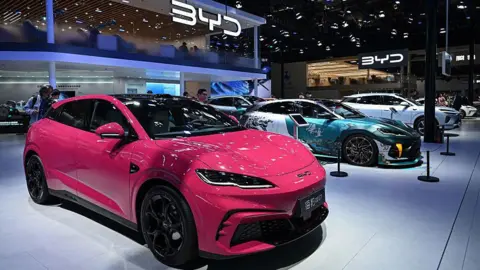
This bold position was reinforced at the recent Beijing Auto Show, now considered the largest auto industry event in the world. With more than 1,400 vehicles on display from hundreds of companies, the spotlight clearly belonged to Chinese carmakers, and BYD stood out as the leader of the pack.
A Global Surge in EV Demand
The recent spike in oil prices due to the conflict in Iran has changed how consumers around the world think about transportation. As fuel costs rise, electric vehicles look increasingly attractive, especially for daily drivers looking to manage household expenses. China, already the world’s top producer of EVs, is well positioned to meet this growing demand.
While Chinese EV makers remain largely locked out of the American market, they are seeing strong momentum across Asia, Europe, and other regions. BYD, which surpassed Tesla last year to become the world’s largest EV seller, is leading this shift.
BYD’s Confident Stance on the US Market
In a recent BBC interview at the Beijing Auto Show, BYD executive vice president Stella Li made the company’s position crystal clear. According to Li, BYD is succeeding without selling in the US today. The company is not focused on chasing American customers, especially when so many other markets are eager to buy its vehicles.
Some of the key markets driving BYD’s global growth include:
- Brazil, where electric vehicles are gaining traction quickly
- The United Kingdom, where consumer interest has been strong
- Europe more broadly, with sales rising sharply
- Multiple Asian markets where infrastructure is improving rapidly
Li emphasized that consumers are noticing the daily savings that come with EVs, especially when oil prices rise. EVs are now seen as a way to save money every day, not just over the long term. That message resonates strongly in the current economic climate.
Capacity Is the Real Challenge
In a striking comment, Li said that BYD is not struggling with demand at all. Instead, the company is struggling with capacity. Demand is so high that BYD cannot produce vehicles fast enough to satisfy global orders. That is a remarkable position for any car manufacturer to be in, especially one operating without one of the world’s largest consumer markets.
This kind of demand pressure highlights a key dynamic in the global auto industry. EVs are no longer a niche category. They are increasingly seen as the default option for new car buyers in many parts of the world. Chinese manufacturers are taking advantage of this moment, building scale and brand recognition at a rapid pace.
Flash Charging Could Be a Game Changer
One of the biggest hurdles to wider EV adoption has always been charging speed. Many potential buyers worry about how long it takes to recharge a battery and whether they will be able to find convenient charging stations. BYD believes its new flash charging technology could change that conversation.
According to Li, flash charging can add hundreds of kilometers of range in just minutes. That is a dramatic improvement over conventional charging speeds and could remove one of the last major reasons consumers hesitate to switch from gasoline cars to EVs.
If flash charging delivers on its promise at scale, it could give BYD a significant competitive advantage. Customers who once felt locked into combustion engine vehicles due to charging concerns may finally be willing to make the leap.
A Complex Geopolitical Landscape
BYD’s global expansion is happening against a backdrop of intense geopolitical complexity. Chinese EV manufacturers face tariffs, regulatory scrutiny, and political concerns in many of the world’s largest markets. The United States in particular has voiced strong concerns about:
- Chinese government subsidies for EV manufacturers
- Data privacy and security risks
- Potential national security implications
- Unfair competitive practices
These concerns have made it difficult for Chinese automakers to gain a foothold in the US. However, Li argues that BYD is winning recognition in other markets where regulatory environments are more open. The company’s growth in the UK, for example, demonstrates that Chinese EVs can succeed in mature markets when given the chance.
Beyond Cars: BYD as an Ecosystem
One of the most interesting parts of BYD’s strategy is how the company defines itself. Li was quick to note that BYD is much more than just a car manufacturer. The company also produces a third of global smartphone components, making it a critical supplier in the consumer electronics industry. BYD is also a leading player in:
- Battery storage solutions for residential and industrial use
- Solar panel manufacturing
- Electric buses and commercial vehicles
- Trucks and heavy duty transportation
This diversified approach positions BYD as an ecosystem rather than a single product company. That kind of breadth provides revenue stability and allows the company to invest in cross sector innovation. Many of BYD’s car technologies benefit from advances in its other business lines, and vice versa.
Innovation on Display in Beijing
While BYD captured most of the headlines at the Beijing Auto Show, other Chinese companies also demonstrated impressive innovation. X-Peng, for example, unveiled a new six seater electric SUV. The company’s chief executive He Xiaopeng announced plans to introduce humanoid robots later this year and to begin manufacturing flying cars by 2027.
This kind of forward thinking ambition reflects the rapid pace of technological development in China’s auto industry. Companies are no longer just competing on traditional metrics like price and design. They are racing to introduce entirely new categories of products that could reshape transportation.
Foreign Carmakers Adapt or Fall Behind
For decades, foreign carmakers like Volkswagen, Toyota, and Ford dominated the Chinese auto market. That era is rapidly fading. Today, those same companies are struggling to keep up with the speed and innovation of Chinese rivals. Many have decided that partnership is the only viable path forward.
Recent collaborations include:
- BMW partnering with battery maker CATL
- Audi adopting Huawei’s driving assistance systems
- Volkswagen co developing EVs with XPeng
These partnerships reflect a new reality in the global auto industry. Chinese companies are not just catching up to their foreign rivals. In many cases, they are setting the pace, particularly in EV technology, batteries, and software integration.
Intense Competition Within China
While BYD is dominating internationally, the situation at home is more complicated. The Chinese EV market is fiercely competitive, with dozens of manufacturers locked in aggressive price wars and rapid product cycles. Even market leaders like BYD have not been immune to the pressures.
Some interesting points about the domestic challenges include:
- BYD’s domestic sales have fallen for seven consecutive months.
- Price competition has squeezed profit margins industry wide.
- Lower prices have begun to soften consumer demand at home.
- New entrants continue to flood the market with fresh models.
In contrast, BYD’s European sales rose by an astonishing 156 percent in the first three months of this year. That gap between domestic and international performance is shaping the company’s strategic priorities.
Industry Consolidation on the Horizon
Li believes that the intense competition in the EV industry will inevitably lead to consolidation. She compared the current moment to past industry cycles, including the rise of Japanese carmakers in the 1990s and the more recent emergence of South Korean brands. In both cases, many companies entered the market, but only a handful survived to dominate the long term landscape.
The same pattern is likely to play out in the EV industry. Companies that can scale efficiently, innovate consistently, and build strong global brands are likely to thrive. Those that cannot will probably be acquired, merge with rivals, or disappear entirely.
What This Means for Global Consumers
For consumers around the world, the rise of Chinese EV makers could bring several benefits and considerations. These include:
- Greater choice in EV models at various price points
- Faster innovation in batteries, charging, and software
- More aggressive pricing competition
- New driving and ownership experiences
- Questions about data privacy and supply chain dependence
Buyers will need to weigh these factors as they consider their next vehicle. Whether someone chooses a Chinese EV, a domestic alternative, or a traditional gasoline vehicle, the global landscape is changing fast.
Key Takeaways
To summarize the most important points from this story:
- BYD says it does not need the US market to thrive globally.
- Demand for Chinese EVs is rising sharply due to higher fuel prices.
- BYD is struggling with capacity rather than demand.
- The company’s flash charging technology could be a major competitive edge.
- Chinese carmakers are dominating the Beijing Auto Show with innovative models.
- Foreign automakers are increasingly partnering with Chinese firms to stay competitive.
- BYD’s European sales surged 156 percent in early 2026.
- Industry consolidation is expected as competition intensifies.
Final Thoughts
The story of BYD without US market access is a powerful example of how global business strategies are evolving. Once upon a time, success in the United States was considered essential for any major automaker. Today, BYD is showing that it is entirely possible to build a thriving global business without American customers, as long as a company has the right products, strategy, and timing.
Whether or not that situation changes in the future remains to be seen. Trade relations, political shifts, and consumer preferences all play a role in shaping where companies can compete. But for now, BYD is making the most of its opportunity. With surging demand, strong innovation, and an expanding global footprint, the company has positioned itself as one of the most important players in the future of mobility.
The next few years will be decisive for the entire EV industry. Innovation will accelerate, competition will intensify, and consolidation will reshape the landscape. BYD is betting that it will not just survive this transformation but emerge as one of its biggest winners. Based on the company’s recent performance and bold strategy, that bet looks well placed.