


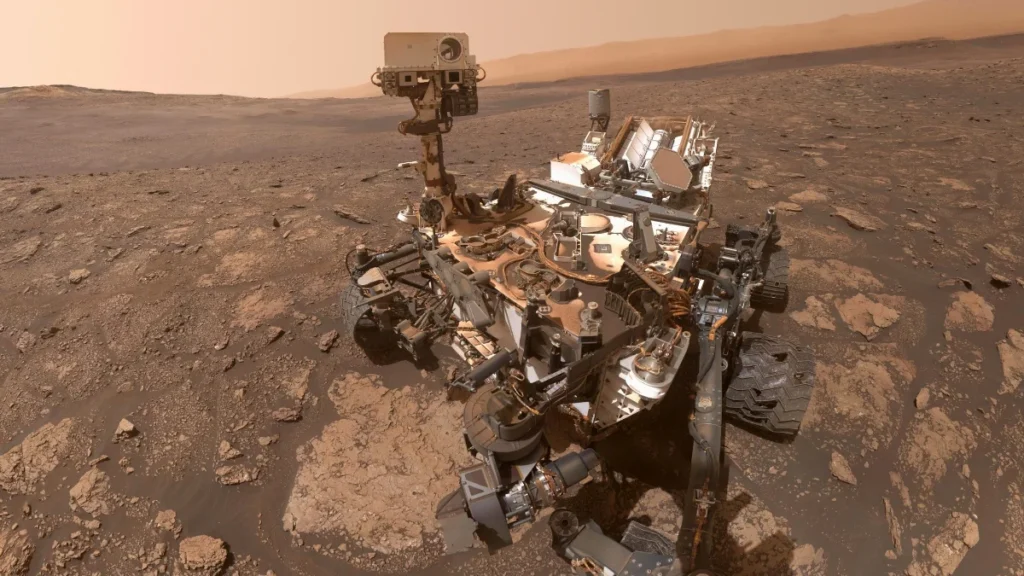
NASA’s Curiosity rover has done it again. In a chemistry experiment that had never been attempted on any world besides Earth, the veteran Mars explorer has detected new organic molecules that scientists describe as the building blocks of life. The findings don’t prove that Martians once existed, but they do strengthen the case that the red planet was once a far more hospitable place than it is today.
A Historic Experiment on the Surface of Mars
Scientists announced Tuesday that Curiosity successfully carried out an unprecedented chemistry experiment in 2020, one that has now yielded remarkable results. The rover detected more than 20 organic molecules, several of which had never been confirmed on Mars before.
Amy Williams, an astrobiologist working on the Curiosity mission and lead author of the new study, emphasized just how significant this moment was. The experiment had never been attempted on another world, and her team knew they had to get it right. With only two attempts available, the pressure was intense. Fortunately, the gamble paid off, and the results are being celebrated as a major step forward in the search for life beyond Earth.
What Curiosity Actually Found on Mars
The discovery includes a fascinating range of organic molecules, but a few stood out as particularly meaningful.
Benzothiophene: A Molecule Connecting Mars and Earth
One of the key detections was benzothiophene, a molecule previously found in meteorites and asteroids. This is significant because it suggests a common source of organic material spreading throughout the solar system. As Williams explained, the same materials that fell to Mars from meteorites also fell to Earth, likely providing the essential ingredients that made life on our planet possible.
A Nitrogen-Containing Precursor to DNA
Even more intriguing was the detection of a nitrogen-containing molecule that Williams described as a precursor to the building blocks of DNA. In other words, researchers are now looking at prebiotic chemistry on Mars, the kind of raw material that can, under the right conditions, eventually lead to life.
Williams summed it up beautifully. The team is seeing the building blocks for life preserved in Martian rocks for billions of years.
Why This Mars Discovery Matters
It’s important to be clear about what this finding does and doesn’t prove. The organic molecules detected by Curiosity are not definitive evidence that life ever existed on Mars. There are several ways these molecules could have arrived:
- They could have formed through non-biological chemical processes on Mars
- They could have been delivered by meteorites crashing into the planet’s surface
- They could, potentially, be leftover traces of ancient biological activity
What the discovery does prove is equally exciting. These crucial chemical clues have been preserved on the Martian surface for more than three billion years. That’s a staggering length of time, and it speaks to the power of the red planet as a kind of frozen archive for the history of our solar system.
A Very Different Mars, Billions of Years Ago
To understand why this discovery is such a big deal, you have to picture Mars not as the dry, dusty world we see today, but as the planet it used to be billions of years ago.
Back then, scientists believe Mars was covered with vast lakes and flowing rivers of liquid water. Water, as far as we know, is absolutely essential for life. The possibility that ancient Mars once had the right conditions for life to emerge has driven decades of exploration and research.
Curiosity landed inside Gale crater in 2012, a location chosen specifically because it was once a massive lake bed. Ever since, the rover has been patiently searching for chemical fingerprints that could indicate whether life ever took hold there. The new discovery of complex organic molecules adds weight to the idea that Mars was once a much friendlier place than the frigid desert it is today.
The Challenge of Proving Life Existed on Mars
Finding definitive proof of past life on Mars is one of the biggest challenges in all of science. Organic molecules alone, while exciting, aren’t enough to make that extraordinary claim. Scientists need much stronger evidence before announcing that life once existed on another planet.
According to Williams, one of the most promising paths forward would be to bring Martian rocks back to Earth. In well-equipped laboratories here on our planet, researchers could run far more sophisticated analyses than any rover could perform remotely.
The Troubled Status of Mars Sample Return
NASA’s Perseverance rover has already been collecting promising rock samples for exactly this purpose. The plan was to retrieve them as part of a mission called Mars Sample Return, which would be the first-ever round trip to another planet.
Unfortunately, the mission has hit major obstacles. Following a US Congress vote in January, the Mars Sample Return program was effectively canceled. That decision has left the scientific community disappointed and uncertain about when, or if, those carefully collected samples will ever make it back to Earth for detailed study.
What Comes Next for Mars Exploration
Even with the setback to Mars Sample Return, there are still reasons to be optimistic about the future of Mars science. Curiosity’s successful experiment has opened new doors for missions yet to come.
The Role of TMAH Chemistry
The experiment relied on a chemical called TMAH, which Curiosity used to prepare Martian samples for analysis. The new study, published in the journal Nature Communications, demonstrated that TMAH-based experiments work reliably on other worlds. That’s valuable knowledge for mission planners designing future rovers and landers.
The Rosalind Franklin Rover Is Coming
The European Space Agency’s Rosalind Franklin rover is next in line to put these techniques to use on Mars. This rover has a particularly exciting feature: a drill significantly longer than Curiosity’s, allowing it to reach deeper beneath the surface where organic molecules may be even better preserved.
The mission has faced numerous delays over the years, but last week NASA announced a firm target for the Rosalind Franklin rover’s launch. It’s now scheduled to blast off toward Mars in late 2028.
Why Deeper Drilling Could Change Everything
The depth at which samples are collected matters enormously. On the Martian surface, organic molecules are exposed to harsh radiation from the Sun that can gradually break them down. But just a short distance below the surface, those same molecules can be far better protected.
Rosalind Franklin’s ability to drill deeper could mean access to:
- Better-preserved organic molecules
- Samples less contaminated by surface radiation damage
- Potentially more complex chemistry that would otherwise have been destroyed
If Curiosity found exciting molecules near the surface, imagine what might be hiding just a few feet down.
The Bigger Picture of Life in the Universe
Every discovery like this one adds a piece to an enormous puzzle. Humanity has been asking whether we’re alone in the universe for as long as we’ve been able to look up at the stars. Mars represents our best nearby opportunity to answer that question, and each new finding narrows the gap between speculation and scientific understanding.
The fact that the same molecules that helped seed life on Earth also rained down on Mars is genuinely extraordinary. It suggests that the ingredients for life are common throughout our solar system, and perhaps throughout the galaxy. Whether Mars ever took those ingredients and did something with them remains the great unanswered question.
A Remarkable Chapter in Space Exploration
Curiosity launched in 2011 and landed on Mars in 2012. More than a decade later, it continues to deliver breakthrough science that would have been unimaginable when it first rolled onto the Martian surface. This latest finding cements its place as one of the most successful planetary missions in history.
The Unsung Heroes of the Mission
It’s worth taking a moment to appreciate the engineers, scientists, and mission controllers who have kept Curiosity operating for so long. Running a delicate chemistry experiment on a rover sitting millions of miles away, with limited resources and only two chances to succeed, is nothing short of remarkable. The people behind the mission deserve enormous credit for making discoveries like this possible.
Looking Ahead to the Next Great Discovery
Mars continues to be one of the most captivating places in our solar system, and the story of its exploration is far from over. As Curiosity keeps rolling, as Perseverance collects samples, and as Rosalind Franklin prepares for its 2028 launch, the coming years promise even more extraordinary revelations about our mysterious planetary neighbor.
Someday, perhaps soon, we may finally have the answer to one of humanity’s oldest questions. Did life ever exist beyond Earth? Until then, each new organic molecule detected on Mars brings us a little closer to the truth, and the universe feels just a little bit less empty.