


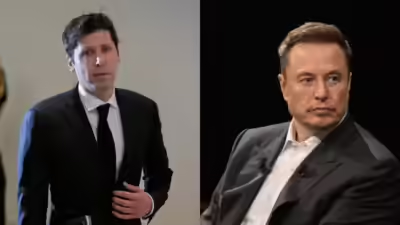
Elon Musk OpenAI Lawsuit Heats Up With Personal Insults and Massive Damage Claims
The Elon Musk OpenAI lawsuit officially kicked off on Monday, April 27, and the Tesla CEO wasted no time turning the legal proceedings into a personal battle. Just as the trial got underway, Musk took to X, the platform he owns, to launch a fresh wave of public attacks against OpenAI’s leadership.
In a series of biting posts, Musk mockingly referred to OpenAI CEO Sam Altman as “Scam Altman” and co-founder Greg Brockman as “Greg Stockman,” accusing the two executives of stealing what he describes as a charity that he himself helped build.
The Origins of OpenAI
To understand why Musk is so publicly furious, it helps to revisit OpenAI’s beginnings. The artificial intelligence research organization was founded back in 2015 by a notable group of tech figures, including Sam Altman, Greg Brockman, Elon Musk, Ilya Sutskever, Wojciech Zaremba, and John Schulman. From the outset, OpenAI was structured as a non-profit, with a mission centered around developing AI for the broader benefit of humanity.
That non-profit foundation has become the heart of the current legal dispute. Musk argues that the company has drastically strayed from its founding ideals, transforming into something fundamentally different from what was originally pitched to him and the public.
A Lawsuit That Won’t Quit
This isn’t Musk’s first attempt at taking OpenAI to court. He initially filed a lawsuit in November 2024, alleging that the company had betrayed its original mission. He later withdrew that case the same year, only to revive the legal action in early 2026 with renewed determination.
The trial officially began with the appointment of a nine-person jury, signaling that this fight is going to play out in full public view rather than being settled quietly behind closed doors.
The Public Tirade on X
In one of his Monday posts, Musk didn’t hold back. He claimed that “Scam Altman” and “Greg Stockman” had simply stolen a charity, full stop. According to Musk, Brockman has reportedly received tens of billions in stock for himself, while Altman has secured numerous OpenAI-related side deals that include personal stakes, drawing comparisons to a Y Combinator-style arrangement.
Musk further alleged that following the lawsuit, Altman would also be awarded tens of billions in stock directly. He framed the entire situation as a fundamental question for the country, asking whether Americans want to establish a legal precedent allowing charities to be effectively looted. According to Musk, allowing this to stand would undermine charitable giving in the United States permanently.
He went on to assert that he could have launched OpenAI as a for-profit company from the start. Instead, he chose to found it, fund it, recruit key talent, and pass along everything he knew about building successful startups, all with the public good in mind. His central grievance remains that the founders he trusted essentially walked off with what was meant to be a charitable enterprise.
In a separate post, Musk made things even more direct, claiming that the entire foundation of OpenAI is built on a lie.
A Massive Damage Claim
The numbers involved in this lawsuit are staggering. According to a person familiar with the case, Musk is seeking $150 billion in damages. He has also stated that any proceeds from the case would be directed to OpenAI’s charitable arm, framing the lawsuit as an effort to restore the original mission rather than personally enriching himself.
That figure alone makes this one of the most ambitious legal claims ever filed in the tech industry. Whether the court awards anywhere near that amount or rules in OpenAI’s favor entirely, the outcome will inevitably reshape parts of the AI industry.
OpenAI Fires Back
Unsurprisingly, OpenAI hasn’t taken these attacks lying down. The company has dismissed the lawsuit as a distraction motivated primarily by competitive jealousy. OpenAI representatives have pointed out that Musk himself now leads xAI, a rival AI company that competes directly with OpenAI’s offerings, including its flagship product ChatGPT.
From OpenAI’s perspective, this trial is not really about charitable mission preservation. It’s about Musk attempting to slow down or damage a competitor by tying it up in expensive and reputation-battering litigation. They argue that his real goal is to clear space for xAI to grow, rather than to genuinely restore some lost public-good mission.
A Personal Feud With Industry-Wide Implications
The personal animosity between Musk and Altman has been building for years, with both men making subtle and not-so-subtle jabs at each other in the press and on social media. This trial transforms what has often felt like a feud into a full-blown courtroom showdown, complete with billions of dollars on the line and millions of people watching.
Beyond the personalities involved, the case raises serious questions for the entire AI industry. If Musk wins, the way technology companies use non-profit structures to launch ambitious projects could face significant new restrictions. If OpenAI prevails, the case could embolden other organizations to follow similar paths in transitioning from non-profit to for-profit operations.
Why This Trial Matters
This isn’t just another celebrity-driven legal spectacle. The Elon Musk OpenAI lawsuit touches on deeply important issues, including how non-profit missions are protected, what obligations founders have toward original charters, and how billion-dollar companies should be accountable when their structures evolve.
It also highlights a tension at the core of modern AI development. Many of the biggest players in the industry began with idealistic goals around safety, ethics, and benefiting humanity. As these companies have become commercially valuable, those original missions have come under increasing strain.
What Comes Next
The trial is expected to be one of the most closely watched legal battles in Silicon Valley’s recent history. With each new development likely to make front-page news, both Musk and Altman are bracing for a long, contentious process.
For now, X users can expect more provocative posts from Musk, while OpenAI’s communication team will likely continue pushing back through carefully measured statements. Whether the courtroom drama matches the social media drama remains to be seen, but one thing is certain: this is far from over, and the implications will reach well beyond the personal grievances of the men involved.
The world is watching, and the verdict could change how the AI industry operates for years to come.