


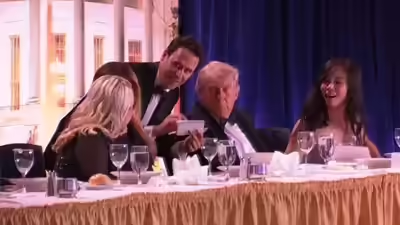
White House Correspondents Dinner Shooting Sends Shockwaves Through Washington as Gunman Charges Toward Trump
The White House Correspondents Dinner shooting on Saturday night turned what should have been an evening celebrating journalism into a moment of national crisis. A man armed with guns and knives stormed the lobby outside the prestigious annual event at the Washington Hilton, charging toward the ballroom where President Donald Trump was scheduled to speak. The chaotic encounter with Secret Service agents resulted in shots being fired as guests dove under tables, but thankfully the president emerged uninjured.
This dramatic incident has raised serious questions about security at high-profile Washington events and added another harrowing chapter to what has become a deeply troubling pattern of threats against the current president. Here’s a detailed look at what happened, who was involved, and what it all means.
The Attack Unfolds
The night was meant to be a celebration of the First Amendment and the journalism profession. Hundreds of prominent journalists, celebrities, government officials, and dignitaries had gathered at the Washington Hilton for the annual White House Correspondents’ Association Dinner. This year’s event was particularly anticipated because it marked the first time President Trump had attended the dinner since beginning his current term.
Guests were dining on a spring pea and burrata salad when the noise began. Trump initially thought it was a tray dropping, but several journalists in attendance quickly recognized the sounds for what they were — between five and eight gunshots fired in rapid succession.
The atmosphere transformed instantly. Audible gasps echoed through the ballroom as people realized something serious was happening. Hundreds of journalists immediately got on their phones to call in information, while Secret Service agents and other authorities swarmed the room. Hundreds of guests dove under their tables seeking cover.
Someone yelled “Out of the way, sir!” while others shouted at people to duck down. In one corner of the ballroom, a “God Bless America” chant began as the president was escorted offstage by his security detail.
The Gunman’s Path of Chaos
Video footage that Trump later posted shows the suspect running past security barricades as Secret Service agents rushed to intercept him. The man, who officials say was a guest at the Washington Hilton where the dinner was being held, made it remarkably close to the ballroom before being stopped.
In the ensuing confrontation, the gunman opened fire. One officer was shot in his bullet-resistant vest but is recovering from the impact. The suspect was eventually tackled to the ground without sustaining injuries himself, though he was being evaluated at a hospital following the incident.
Authorities believe the suspect acted alone in carrying out the attack, though they have not yet publicly identified his intended target or described a motive. The investigation is ongoing, with the FBI examining evidence collected from the scene.
Identifying the Suspect
Two law enforcement officials speaking to The Associated Press on the condition of anonymity identified the shooting suspect as Cole Tomas Allen, 31, of Torrance, California. Allen is now facing two firearm-related charges, including a count of assaulting an officer with a deadly weapon. He is expected to appear in court on Monday.
The fact that the suspect was a registered guest at the hotel — rather than someone who had to breach external security — highlights significant gaps in how high-profile events at venues that remain open to the public are protected. The Hilton hotel typically remains open to regular guests during the correspondents’ dinner, with security focused primarily on the ballroom itself rather than the broader property.
Trump’s Response
President Trump was rushed off the stage when the shooting began. Initially, Secret Service agents covered him in place before quickly escorting him and First Lady Melania Trump out of the room. The president briefly stumbled on his way offstage but was steadied by his security detail.
Trump was then held for some time in a secure presidential suite at the hotel — a special area created decades ago specifically for circumstances like this. As the situation developed, organizers initially attempted to resume the event. Hotel staff began refolding napkins and refilling water glasses, while aides adjusted the teleprompter for the president’s planned remarks.
Ultimately, however, the Secret Service advised that Trump should return to the White House for safety, and the dinner was scrapped for the evening.
About two hours after the incident, Trump addressed reporters at the White House, still in his tuxedo. His words were striking in their characteristic directness. He observed that when you’re impactful, people come after you — when you’re not, they leave you alone. According to Trump, authorities seemed to think the attacker was a lone wolf operating without coordination from any larger group.
The president acknowledged the unprecedented nature of the security challenges he faces. He noted that today requires levels of security that probably nobody has ever seen before, but he also struck a defiant note, saying that they wouldn’t allow anybody to take over our society.
Trump expressed hope that the dinner would be rescheduled within 30 days.
A Disturbing Pattern of Threats
This incident marks the third time since 2024 that the president has faced an attacker in his immediate vicinity. The most notable previous attempt occurred in Butler, Pennsylvania, where an assassination attempt injured Trump and killed a local firefighter. The pattern of threats has prompted significant changes to presidential security protocols.
The repeated nature of these incidents has put extraordinary pressure on the Secret Service, which is now operating under unprecedented circumstances. Each successful prevention of a serious incident represents a victory, but each near-miss also raises questions about how to better protect the president going forward.
For political observers and security experts, the Saturday night incident provides another troubling data point in what has become an ongoing conversation about political violence in America.
The FBI Investigation
FBI Director Kash Patel stood alongside the president at the White House later Saturday night, speaking about the ongoing investigation. According to Patel, the agency is examining a long gun and shell casings that were recovered from the scene. Investigators are also interviewing witnesses from the dinner to build a complete picture of what happened.
Patel urged anyone with information about the incident to come forward to assist the investigation. The thoroughness of the FBI response reflects the seriousness with which the federal government is treating the attack.
In coming days and weeks, more details about the suspect’s background, motivations, and potential connections will likely emerge. The investigation will need to determine not only how the attack was planned and executed but also how the suspect was able to get so close to the president despite extensive security measures.
Security Concerns Take Center Stage
The incident has immediately raised pressing questions about security precautions at high-profile Washington events. The Washington Hilton has hosted the correspondents’ dinner for years, and security has typically been focused on the ballroom rather than the hotel at large.
This approach has created vulnerabilities in past years. Hotel guests not attending the dinner have generally not been subjected to extensive screening, leading to occasional disruptions in lobby and other public spaces. Past incidents have included protests where security had to remove guests who unfurled banners or staged demonstrations. However, those past disruptions were typically peaceful in nature.
The suspect’s status as a registered hotel guest highlights how someone with hostile intent could potentially exploit the relatively open nature of the Hilton’s general security to position themselves close to high-value targets.
The question now is whether security protocols at the Hilton and similar venues need to be fundamentally restructured for events involving the president. More extensive screening of all hotel guests during such events, expanded perimeters around presidential events, and additional measures to identify potential threats well in advance of incidents like this all seem like obvious areas for review.
A Historical Echo
There’s a haunting historical resonance to Saturday night’s events. In 1981, President Ronald Reagan was shot by John Hinckley Jr. outside the very same Washington Hilton. That assassination attempt prompted significant redesigns of the property to enhance security, including the creation of the special presidential suite near the entrance where chief executives could be quickly taken in case of emergency.
Trump was briefly held in that very suite after Saturday’s incident — a chilling reminder that decades of security improvements at the venue weren’t enough to prevent another high-profile attack near the same building.
The fact that this happened at the same hotel where Reagan was shot adds another layer of historical weight to an already significant moment. It also reinforces the need for continued vigilance and adaptation of security measures as new threats emerge.
Reactions From Across the Political Spectrum
The shooting prompted reactions from political leaders on both sides of the aisle. House Speaker Mike Johnson, a Republican who attended the event with his wife Kelly, said they were both praying for the country.
House Democratic Leader Hakeem Jeffries of New York wrote on social media that the violence and chaos in America must end. This kind of bipartisan recognition of the dangers facing political figures and the need to address political violence represents one of the few areas of agreement in an otherwise deeply divided political environment.
Republican Representative Mike Lawler of New York, who was at the dinner as a guest, described the experience of hearing the initial pop and not knowing what was happening. He said he frequently receives death threats himself and worries that people don’t fully appreciate how serious the problem of political violence has become.
Lawler’s observation captures something important about the current moment. While most Americans are aware that political tensions have escalated in recent years, the day-to-day reality for politicians and other public figures involves constant threats and security concerns that go far beyond what most people realize.
The Aftermath in the Ballroom
Inside the ballroom, the immediate aftermath of the attack was a study in controlled chaos. Vice President JD Vance was removed from the room first as Secret Service agents prioritized protecting the executive branch’s leadership.
Members of the National Guard took up positions inside the building as guests were allowed to leave but not immediately reenter. Outside the hotel, additional National Guard members and other authorities flooded the area as helicopters circled overhead, creating an atmosphere of heightened security.
Weijia Jiang, president of the White House Correspondents’ Association, made a brief statement promising that the event would happen again. Shortly after her words, staff began breaking down table settings and the presidential lectern, ending what had been intended as a celebratory evening for journalism.
The Original Purpose of the Evening
Saturday’s dinner was meant to be a particularly significant event. As the first White House Correspondents’ Association Dinner Trump attended as president since his current term began, it would have offered a unique window into his administration’s complex relationship with the press.
Past presidents attending the dinner have typically spoken about the importance of free speech and the First Amendment, often delivering lighthearted roasts of individual journalists in the process. The mix of journalists, celebrities, and government officials who attend creates a unique social environment in Washington.
This year’s dinner was being closely watched given Trump’s well-documented frustrations with much of the mainstream press. Many were curious to see how he would address the assembled journalists and what tone he would set for his administration’s ongoing relationship with the media. The mentalist Oz Pearlman had been hired as the featured entertainment, replacing the comedians who have traditionally performed at past events.
Trump entered the banquet hall to the strains of “Hail to the Chief” and greeted prominent journalists on the dais. He paused to laud White House Press Secretary Karoline Leavitt with what observers described as a cheerful pointing of his finger. The atmosphere in the moments before the attack was reportedly one of cautious anticipation about what the evening might bring.
A Nation at War
The dinner was taking place against the backdrop of a nation at war, adding another layer of significance to the gathering. Leaders of a country in conflict mingled with celebrities, journalists, and even Triumph the Insult Comic Dog in what was supposed to be an evening of camaraderie despite political differences.
This context makes the attack even more striking. At a moment when the country needs unity and resolve, an act of violence struck at one of the few remaining venues where political opponents and journalists from competing outlets gather in shared celebration of constitutional principles.
The incident inevitably raises questions about whether such gatherings can continue in their current form, or whether security concerns will fundamentally reshape how Washington society operates.
The Road Ahead
In the coming days and weeks, several important developments are likely to emerge. The FBI investigation will provide more details about the suspect’s motivations and any potential connections to broader threats. Court proceedings against Cole Tomas Allen will begin Monday and continue through the legal process.
The White House Correspondents’ Association will need to make decisions about rescheduling the dinner. Trump’s hope that it could happen within 30 days seems ambitious given the security review that will inevitably be required, but the organization will likely make every effort to demonstrate that the journalism community will not be intimidated by violence.
Security protocols for high-profile Washington events will undergo significant review. The success of the Secret Service in preventing the attack from reaching the president demonstrates the value of existing protections, but the proximity of the suspect to the ballroom shows that improvements are still needed.
Final Thoughts
The White House Correspondents Dinner shooting represents a stark reminder that political violence remains a serious threat in modern America. While the immediate crisis ended with the president safe and the suspect in custody, the broader issues raised by the incident will continue to affect Washington and the country for some time.
The attack was directed at one of America’s most prominent celebrations of First Amendment values, making it particularly disturbing as a symbolic strike against the institutions of free expression. That it was thwarted by quick-acting security personnel speaks to the dedication of those who protect public figures and events. That it came so close to succeeding speaks to the ongoing challenges of providing security in an era of heightened threats.
For President Trump, the incident is the latest in a troubling series of personal threats. His response, characterized by a mix of acknowledgment of unprecedented security challenges and defiance against those who would use violence, reflects a leader who has had to come to terms with the reality of being repeatedly targeted.
For journalists and the broader political community, the attack is a wake-up call about the personal risks that have become part of public life in America. It will undoubtedly prompt continued conversations about how to maintain open society and democratic institutions while protecting those who participate in them from those who would do them harm.
As investigations continue and security protocols are reviewed, the words of Weijia Jiang from Saturday night carry particular weight — we will do this again. The White House Correspondents’ Dinner, like American democracy itself, must continue despite those who would attack it. The challenge now is ensuring that future gatherings can happen safely, allowing the celebration of journalism and free expression to continue without fear.