


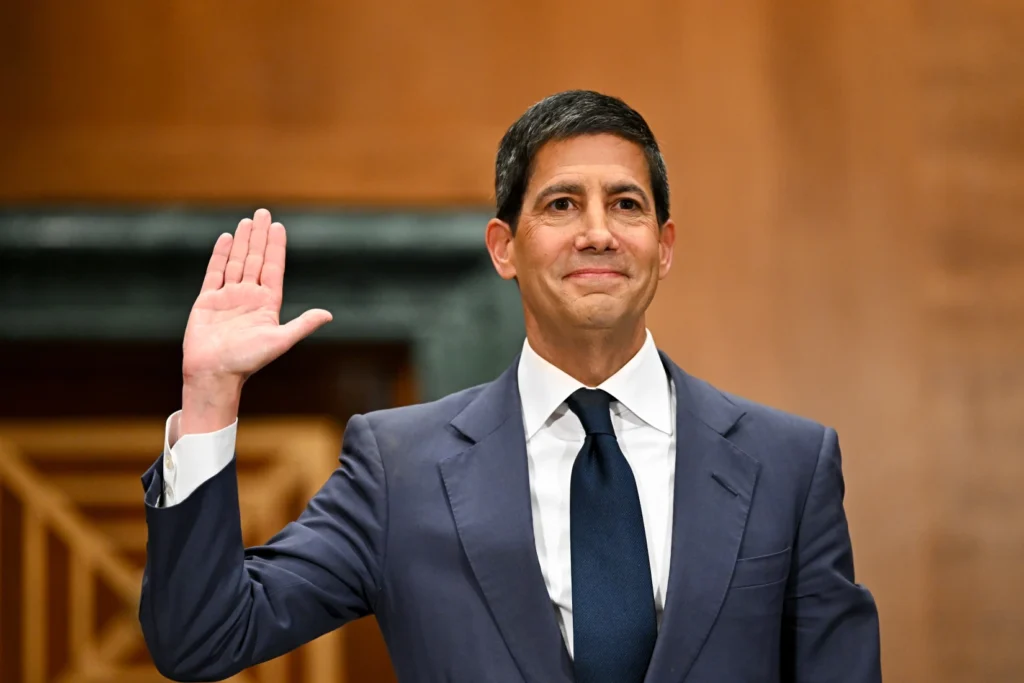
Kevin Warsh Fed Chair Confirmation: Senator Tillis Clears the Path for Trump’s Pick
The Kevin Warsh Fed chair confirmation has just received a major boost as Senator Thom Tillis announced he’s ending his blockade of the nomination, removing the final significant obstacle standing between Warsh and the leadership of America’s central bank. The breakthrough came after the Department of Justice dropped its criminal investigation into current Fed Chair Jerome Powell, satisfying Tillis’s primary concern about the situation.
The Path Becomes Clear
Warsh now appears virtually certain to replace Powell as the next leader of the Federal Reserve when Powell’s current term expires in mid-May. The Senate Banking Committee is scheduled to vote on the confirmation this Wednesday, with the full Senate likely to take up the matter shortly afterward.
Speaking on NBC’s Meet the Press, Tillis explained his decision to move forward. The North Carolina Republican stated he was prepared to advance Warsh’s confirmation, expressing confidence that Warsh would make an excellent Fed chair. He emphasized that the assurances from the DOJ proved essential, particularly his need to confirm the Justice Department wasn’t being weaponized to threaten Federal Reserve independence.
The Stakes of the Tillis Vote
To understand why Tillis’s position mattered so enormously, you have to look at the Senate Banking Committee’s composition. The panel consists of 13 Republicans and 11 Democrats, meaning a single Republican defection would have created a deadlock and blocked Warsh from advancing to a full Senate vote.
Tillis had previously committed to withholding his support for Warsh, even though he personally favored the nominee, until the DOJ ended its investigation of Powell. That investigation centered on alleged cost overruns related to renovations at the Federal Reserve building, an inquiry that critics had labeled politically motivated from its inception.
The Investigation’s Complex Resolution
U.S. Attorney Jeanine Pirro, who serves as the top federal prosecutor in the District of Columbia, announced Friday that her office was transferring the investigation to the Federal Reserve inspector general’s office. This procedural shift effectively ended the criminal probe while preserving the possibility of future investigation if specific conditions emerge.
Tillis revealed he had spoken with DOJ officials following Pirro’s announcement and received clear assurances about the limits of any future inquiry. According to Tillis, officials confirmed the only way an investigation would be reopened would involve a specific criminal referral from the inspector general. He emphasized that they had made absolutely clear the current investigation was completely and fully concluded.
What the DOJ Says
Acting Attorney General Todd Blanche also appeared on Meet the Press, where he addressed questions about whether the Justice Department might reopen its investigation after Warsh’s confirmation. Blanche characterized the matter as now being in the inspector general’s hands, while leaving the door slightly open for potential future action.
He stated that if the inspector general uncovers evidence of criminal conduct, there’s no question the Justice Department would investigate. That formulation gives the inspector general’s process meaningful authority while preventing the appearance that DOJ involvement has truly ended permanently.
The Lingering Appeal
One complication remains in the form of Pirro’s planned appeal of a recent federal judge’s decision that quashed subpoenas issued to the Federal Reserve. Pirro has argued the judge’s ruling interferes with her ability to lead grand jury investigations more generally, framing the issue as broader than just the Powell matter.
Tillis said he received specific assurances on this issue as well. According to his social media post, any appeal of Judge Boasberg’s ruling will focus exclusively on legal principles rather than serving as a backdoor mechanism for reissuing subpoenas to the Fed.
Former federal prosecutors have noted that Pirro faces slim chances of success in any appeal. She has until May 4 to officially file her challenge, leaving relatively little time to prepare the legal arguments.
Warsh’s Ambitious Plans
Warsh hasn’t been shy about his intentions for the Federal Reserve once confirmed. During his confirmation hearing on Tuesday, he explicitly called for what he termed “regime change” at the central bank. His vision involves substantial transformation rather than incremental adjustments to existing practices.
Among the changes Warsh has indicated he wants to pursue:
- Modifying how the Federal Reserve measures inflation across the economy
- Restructuring how the central bank communicates with markets and the public
- Adjusting various operational practices that have evolved over recent decades
- Pursuing what he views as more effective monetary policy frameworks
These represent genuinely substantial proposed changes to an institution that has historically valued continuity and gradual evolution over dramatic transformation.
The Rate Cut Question
President Trump has made his expectations crystal clear about wanting Warsh to push for substantial interest rate cuts after taking office. However, Warsh would need to convince his fellow members of the Federal Reserve’s rate-setting Federal Open Market Committee to join him in any such moves.
The current environment makes that particularly challenging. Energy prices have risen sharply due to the ongoing war in Iran, creating inflationary pressures that make many Fed members understandably skeptical about lowering rates anytime soon. Most committee members have indicated through speeches and votes that they prefer maintaining current rates until inflation moves more decisively toward the 2% target.
This means even after Warsh assumes the chair position, his ability to deliver the rate cuts Trump expects will depend heavily on convincing colleagues whose views he doesn’t directly control.
What Happens to Powell
Tillis’s decision carries significant implications for Powell beyond just his role as chair. Powell can remain a voting member of the Fed’s board of governors until January 2028, even after stepping down as chairman. Powell has indicated recently that he plans to maintain his board position while the threat of prosecution remained, viewing his presence as important during the uncertain period.
With the immediate criminal investigation now ended, Powell faces a genuine decision about whether to continue as a regular board member or potentially step away from the Federal Reserve entirely. His choice will likely shape the dynamics of FOMC meetings for years to come, particularly given his disagreements with Warsh about appropriate monetary policy.
Powell will likely face direct questions about his future plans at the Federal Reserve’s next scheduled press conference on Wednesday, the same day the Senate Banking Committee votes on Warsh’s confirmation.
The Independence Question
Throughout this entire saga, Federal Reserve independence has emerged as the central institutional concern. Critics worried that political pressure on Powell, combined with criminal investigations potentially serving as leverage, threatened the central bank’s ability to make decisions based on economic considerations rather than political ones.
Tillis explicitly cited these concerns in explaining his initial blockade. By demanding genuine assurances about how the DOJ would handle the investigation, he positioned himself as a defender of institutional norms even while supporting the broader political move to install Warsh as chair.
What This Means for Markets
For financial markets watching this transition closely, several considerations matter:
- Continuity in monetary policy isn’t guaranteed under Warsh’s leadership
- Communications style changes could affect how markets interpret Fed signals
- Inflation measurement modifications might alter perceptions of price pressures
- Rate decisions face genuine uncertainty given competing pressures
- Personnel changes throughout the Fed system could accelerate
These factors create heightened uncertainty during a period when global economic conditions already involve substantial complexity from various geopolitical tensions and technological transformations.
Looking at the Bigger Picture
The Kevin Warsh Fed chair confirmation represents far more than just a personnel change at the central bank. It reflects ongoing tension between political administrations seeking aligned monetary policy and institutional traditions of central bank independence that have historically protected such institutions from short-term political pressure.
How Warsh navigates these tensions during his early tenure will significantly influence both Federal Reserve credibility and broader economic outcomes. Moving too quickly to implement Trump-preferred policies could undermine the institutional independence that gives central bank decisions their effectiveness. Moving too slowly could disappoint the administration that nominated him and create ongoing political pressure throughout his term.
Final Thoughts
The Kevin Warsh Fed chair confirmation has now cleared its most significant obstacle, putting one of the most consequential central bank transitions in recent memory firmly on track. With Tillis providing the crucial vote needed to advance the nomination through committee, Warsh appears virtually certain to assume leadership of the Federal Reserve in coming weeks.
The real test will come not in the confirmation process itself but in how Warsh actually leads the institution during what promises to be an exceptionally challenging period for monetary policy. Between energy-driven inflation, ongoing geopolitical tensions, technological disruption, and political pressure for specific outcomes, the next Fed chair faces a genuinely difficult environment for delivering successful economic stewardship.
For everyday Americans wondering what this all means for their mortgage rates, savings accounts, and broader financial situations, the answer is genuinely uncertain. The combination of new leadership, contested policy directions, and complex economic conditions creates unusual unpredictability about where interest rates and inflation are heading. The next several months should provide important early signals about whether Warsh can deliver the substantial changes he’s promised while maintaining the credibility the Federal Reserve needs to function effectively.