


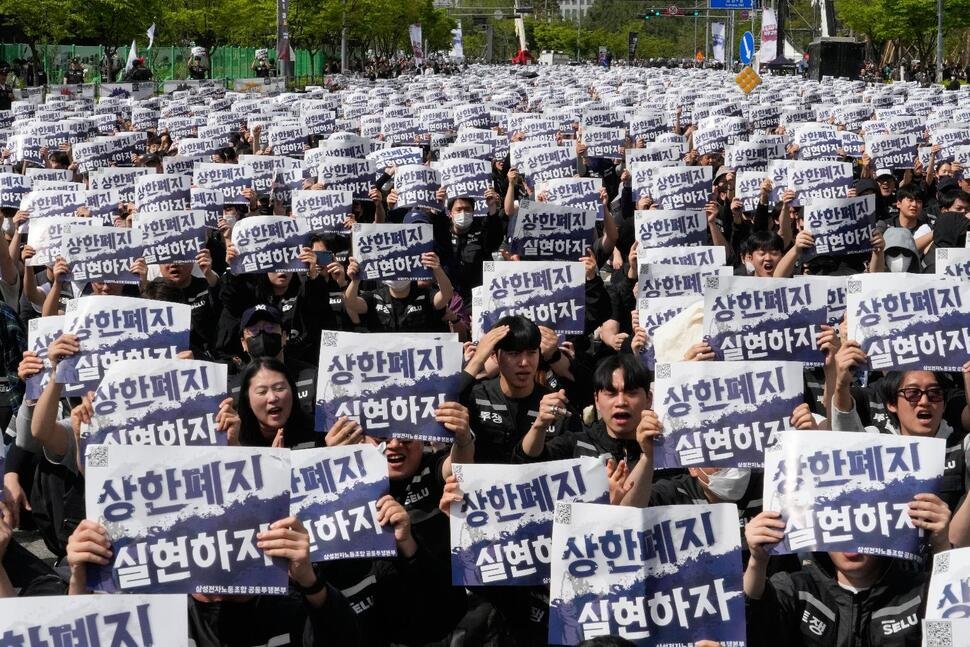
Tens of thousands of Samsung Electronics workers made their voices heard Thursday at the company’s massive semiconductor complex in Pyeongtaek, South Korea. The rally comes at a pivotal moment for the tech giant, as surging demand for artificial intelligence pushes memory chip profits to record highs and workers say they deserve a bigger share of the rewards.
Samsung Workers Rally for Better Compensation
The scene at the Pyeongtaek chip complex was dramatic. Workers held signs, waved banners, and chanted demands for transparent compensation and the removal of bonus caps. The atmosphere was charged, with heavy police presence monitoring the gathering throughout the day.
According to union officials, approximately 40,000 members participated in the protest, though police did not immediately release their own crowd estimate. Either way, this was a massive demonstration by the standards of corporate labor action in South Korea.
The central slogan of the rally was direct and uncompromising. Workers shouted for management to make compensation transparent and eliminate maximum limits on bonuses. Their message was clear: if Samsung is raking in record profits, workers should see more of that money flow into their paychecks.
Choi Seung-ho, a union leader, made the position explicit, speaking through a loudspeaker from atop a crane-mounted structure. He declared that workers wouldn’t stop their fight until their fair demands are met.
The Boom in AI Is Driving Massive Chip Profits
The timing of the rally isn’t coincidental. The semiconductor industry is experiencing an extraordinary boom driven almost entirely by artificial intelligence, and Samsung is one of the biggest beneficiaries.
Record-Breaking Numbers
Samsung forecast earlier this month that its first-quarter operating profit would reach a staggering 57.2 trillion won, equivalent to about $38.6 billion. That would be a record-setting result for the company and a dramatic reflection of just how much money there is to be made selling memory chips for AI applications.
For context, Samsung’s cross-town rival SK Hynix posted its own all-time high quarterly revenue and operating profit for the January through March period, reporting 37.6 trillion won, or about $25.4 billion. SK Hynix attributed its jump to expanding global investments in data centers and other AI infrastructure, which has driven up demand for memory chips across the board.
Why AI Needs So Many Chips
The AI revolution has been incredibly hungry for memory chips. Training and running large language models, powering data centers, and supporting the infrastructure behind AI services all require enormous amounts of memory. Samsung and SK Hynix together produce about two-thirds of the world’s memory chips, meaning they’re positioned to benefit enormously from this wave of demand.
While Samsung has a more diverse business that includes smartphones and consumer electronics, its semiconductor division is the real profit engine these days.
Why Samsung Workers Say Enough Is Enough
The union’s position is straightforward. With profits hitting historic highs, workers feel they’re not receiving their fair share of the gains they’re helping create.
The Union’s Demands
The Samsung Electronics union represents approximately 74,000 workers and has been pushing for significant changes to how compensation works at the company. Among the key demands:
- Removal of caps on bonus payments
- More transparent calculation of compensation
- Rejection of management’s proposal to pay bonuses in the form of restricted stock
- Direct cash rewards that reflect the company’s financial performance
The union has been particularly firm about rejecting the restricted stock proposal. Workers want cash they can actually use, not shares that come with conditions attached.
The Threat of a Major Strike
The union has made it clear that they’re willing to take serious action if negotiations fail. They’ve threatened to stage an 18-day walkout beginning May 21 if management doesn’t come to the table with better terms.
The financial stakes of such action would be enormous. According to union claims, a strike of that length would cost Samsung more than 1 trillion won, equivalent to $676 million, every single day. That kind of economic pressure represents significant leverage, especially at a moment when the company is trying to maximize its position in the AI-driven chip boom.
The Broader Context of Tech Worker Activism
What’s happening at Samsung reflects broader trends in the global technology industry. Workers across the sector are increasingly organized, increasingly vocal, and increasingly willing to use strikes as a tool to push for better conditions.
A Shift in Corporate Power Dynamics
For decades, tech companies managed to avoid serious labor conflicts by offering competitive wages, stock options, and attractive workplace perks. But as the industry matures and specific companies rake in unprecedented profits, workers are asking harder questions about where that money goes and who deserves to benefit.
The size of the Samsung rally, with 40,000 participants, signals that this isn’t a fringe movement or a small group of disgruntled employees. When tens of thousands of workers show up to demand change, it represents a significant shift in the relationship between labor and management.
The Symbolic Weight of Pyeongtaek
The location of the rally matters too. Pyeongtaek is home to one of Samsung’s most important semiconductor manufacturing complexes, and it’s the kind of facility that produces the chips driving the AI revolution. By staging the rally there, workers emphasized their direct role in creating the profits they’re now demanding to share in.
External Pressures on the Chip Industry
While the AI boom has been enormously lucrative for semiconductor makers, the broader picture isn’t entirely rosy. Several external factors are complicating things for companies like Samsung and SK Hynix.
The Middle East Conflict
The ongoing conflict in the Middle East has introduced real uncertainty into the semiconductor supply chain. Chip manufacturing requires a range of specialized materials, and some of the most important ones come from the affected region.
Key concerns include:
- Helium supplies, which are crucial to chipmaking processes
- Bromine, another specialized material used in production
- Rising energy costs that affect the overall cost structure
- Potential shipping and logistics disruptions
In a conference call Thursday, SK Hynix Chief Financial Officer Woo Hyun Kim addressed these concerns directly. He said the company is closely monitoring the situation but doesn’t expect meaningful production impact. SK Hynix has been working to diversify its sourcing of helium and bromine beyond the Middle East and currently maintains sufficient inventory to weather short-term disruptions.
Samsung faces similar pressures, though the company’s scale and resources likely give it significant buffer room as well.
Energy Costs and Manufacturing Economics
Chip manufacturing is extraordinarily energy-intensive. Rising global energy prices, driven partly by geopolitical tensions, add pressure to the bottom line even as revenue climbs. This is another reason the industry’s current success feels fragile, even amid record profits.
What a Samsung Strike Could Mean Globally
The potential for a lengthy strike at Samsung has implications that extend far beyond South Korea.
Global Chip Supply Concerns
If 40,000 or more Samsung workers walked off the job for 18 days, it would create ripple effects throughout the global technology industry. Samsung’s chips end up in countless products worldwide, from smartphones to data centers to automotive electronics. A significant disruption in production would likely cause:
- Delays in delivery of memory chips to major tech companies
- Increased prices for existing chip inventory as customers scramble to secure supply
- Competitive advantages for companies that can maintain production, including SK Hynix
- Potential disruptions to AI infrastructure buildouts happening worldwide
The AI Race and Worker Power
Perhaps the most interesting dynamic is how this situation illustrates the relationship between the AI race and worker power. Tech companies around the world are pouring billions into AI development, and every one of them depends on reliable access to memory chips. That dependency gives chip workers significant leverage in negotiations.
Samsung workers seem to recognize this moment. They understand that if they don’t push for better terms now, when profits are breaking records, they may not have the same opportunity in future business cycles.
The Outlook for Samsung Negotiations
With the strike threatened for May 21, Samsung management has some decisions to make. The company can either come to the table with improved compensation offers, or it can try to ride out whatever work stoppage might occur.
Possible Paths Forward
There are several ways the situation could play out over the coming weeks:
- Samsung offers significant compensation improvements, resolving the dispute before the strike deadline
- Management and union reach a partial agreement that defers some issues while addressing others
- Negotiations break down and the strike proceeds on schedule
- A brief work stoppage occurs before pressure on both sides forces a resolution
Each path has different implications for workers, the company, and the global tech industry. The fact that labor costs and supply chain dynamics are in play simultaneously makes the calculation especially complex.
Why This Moment Matters
What makes the Samsung situation particularly notable is the confluence of factors. Record profits. An AI-driven demand boom. Geopolitical uncertainty affecting supply chains. An increasingly organized workforce. These forces don’t usually align in quite this way, and the outcome could set precedents for how other major tech companies handle labor relations going forward.
The Human Side of the Chip Industry
It’s easy to think of semiconductor manufacturing in abstract terms, like cleanroom facilities, automated equipment, and high-tech processes. But behind all that technology are tens of thousands of real workers whose skills and labor make the industry function.
Many Samsung employees have dedicated years or even decades to the company. They’ve contributed their expertise to developing the products that have made Samsung one of the world’s most valuable corporations. Their demand for a fairer share of the company’s success feels reasonable in that context.
At the same time, Samsung management has to balance worker demands against other priorities, including ongoing investment in research and development, capital expenditures for new facilities, shareholder expectations, and maintaining the competitive edge that has made the company so successful.
A Defining Moment for Samsung and the Chip Industry
However the current dispute resolves, Thursday’s rally will likely be remembered as a significant moment in the history of the semiconductor industry. When 40,000 workers at one of the world’s most important chip manufacturers take to the streets together, it signals that the old ways of doing business may be changing.
For Samsung, the challenge is finding a resolution that addresses worker concerns without undermining the company’s long-term competitive position. For workers, the challenge is pressing hard enough to secure meaningful improvements without triggering actions that could damage the company’s prospects and, by extension, their own jobs.
The coming weeks before May 21 will reveal whether both sides can find common ground. One thing is certain: the eyes of the global technology industry will be watching closely.