


Shares Jittery, Oil Advances on US-Iran Deadlock as Markets Brace for a Tense Week Ahead
Shares jittery, oil advances on US-Iran deadlock as global investors navigate one of the most uncertain weeks in recent memory. With a fragile Middle East ceasefire hanging by a thread, stalled peace negotiations between Washington and Tehran, and the Strait of Hormuz once again at the center of global attention, markets are struggling to find a clear direction.
From equities to oil to currencies, every corner of the financial world is reacting to the rapidly shifting geopolitical picture. And with several major central bank decisions coming up next week, traders have good reason to stay on their toes.
A Market Mood That Can’t Make Up Its Mind
Friday’s trading session captured the indecision perfectly. Global shares bounced between gains and losses, oil resumed its climb, and futures pointed to a subdued open in Europe. Investors appeared torn between the hope that a breakthrough could be just around the corner and the fear that the conflict could drag on or even escalate further.
Here’s how the major markets were moving:
- EUROSTOXX 50 futures slid 0.7%
- FTSE futures dropped 0.76%
- DAX futures dipped 0.25%
- MSCI’s broadest Asia-Pacific index (excluding Japan) rose 0.46%, on pace for a roughly 1% weekly gain
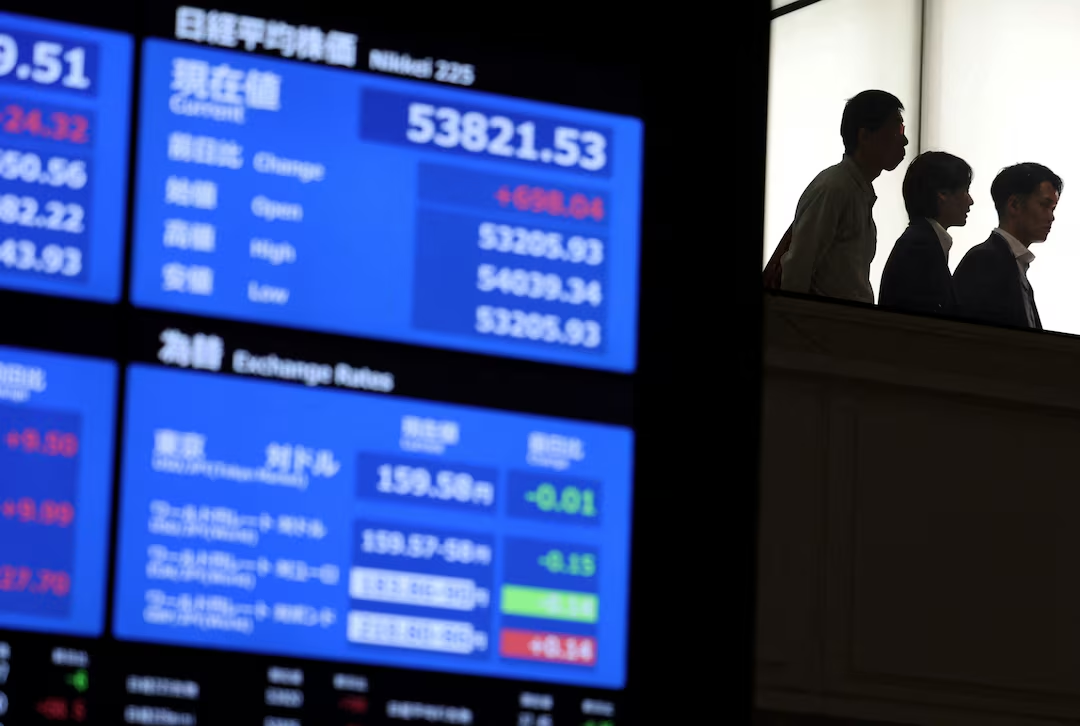
- Japan’s Nikkei added 0.85%
- South Korea and China stocks fell, while Hong Kong was little changed
- Nasdaq futures climbed 0.4%, while S&P 500 futures were flat
The mixed session highlighted just how jumpy investors have become. As Vishnu Varathan, Mizuho’s head of macro strategy for Asia-Pacific, pointed out, calling the current situation a “ceasefire” feels like a stretch when there’s still an active blockade and rolling tensions simmering in the background.
The Strait of Hormuz Remains the Flashpoint
If there’s one place traders are watching with particular intensity right now, it’s the Strait of Hormuz. The narrow waterway, through which a huge share of the world’s oil passes, has once again become a geopolitical pressure point.
On Thursday, Iran released dramatic footage showing commandos in a speedboat storming a massive cargo ship, a pointed display of its ability to disrupt shipping in the region. President Donald Trump responded quickly, ordering the US Navy to “shoot and kill” any Iranian boats spotted laying mines in the strait and increasing demining operations.
The fact that Trump’s harsh comments came just days after he extended the ceasefire with Iran to allow for more peace talks only added to the whiplash. Markets are trying to make sense of a situation that keeps flipping between escalation and diplomacy.
Varathan summed up the prevailing mood when he said the path forward will not be a smooth or linear de-escalation. Investors, in his view, have simply been looking for excuses to take optimistic positions, but few truly believe this crisis will be resolved in a week or two.
Oil Prices Keep Climbing
With the Strait of Hormuz standoff unresolved, oil markets remain under upward pressure. On Friday:
- Brent crude futures climbed 0.55% to $105.65 a barrel
- US crude rose 0.25% to $96.09 a barrel
Any significant disruption to shipping through the strait could send prices sharply higher. Around 20% of global oil supply passes through this waterway, and even small interruptions can ripple through energy markets worldwide.
For consumers and businesses already dealing with elevated energy costs, the prospect of further oil price spikes is a serious concern. Higher energy prices feed directly into inflation, transportation costs, and broader economic activity.
Lebanon-Israel Ceasefire Extension Barely Moves Markets
In what might normally be considered major news, Lebanon and Israel announced a three-week extension to their ceasefire following a high-level meeting at the White House. Yet markets largely shrugged off the development, a telling sign of where investor attention is currently focused.
The muted response reflects a harsh reality. With the Iran situation dominating headlines and oil markets, smaller regional breakthroughs simply aren’t enough to shift sentiment in a meaningful way. Investors want to see broader de-escalation before they’re willing to reprice risk across global markets.
The Yen Teeters on the Edge of 160
Shifting to currency markets, one of the most closely watched developments is the Japanese yen, which is dangerously close to the 160 per dollar mark. That level has long been seen as a potential trigger point for Japanese government intervention.
On Friday, the yen was trading at around 159.78 per dollar, down roughly 0.7% for the week. Japanese Finance Minister Satsuki Katayama wasted no time in renewing warnings about potential intervention, emphasizing that Tokyo is prepared to take “decisive action” in close coordination with the United States.
Carl Ang, a fixed income research analyst at MFS Investment Management, highlighted an interesting wrinkle. With Japan’s Golden Week holiday approaching and market liquidity likely to thin out, the period immediately after the Bank of Japan’s meeting could present an opportune moment for intervention. A sudden yen appreciation within the 150-160 range wouldn’t be entirely surprising under those conditions.
Other Currencies Hold Steady
While the yen gets most of the attention, other major currencies saw more muted moves on Friday:
- The euro traded at $1.1677, on pace for a 0.7% weekly decline
- Sterling was largely unchanged at $1.3462, heading for a 0.4% weekly drop
- The US dollar was broadly stronger, supported by safe-haven demand
The dollar’s strength reflects the classic market pattern of flight to safety during times of geopolitical uncertainty. When investors are worried, they tend to park their money in assets perceived as low risk, and the US dollar remains at the top of that list.
Central Bank Decisions Loom Large
Next week will be packed with major central bank meetings that could significantly influence market direction. On the calendar:
- The US Federal Reserve
- The European Central Bank
- The Bank of England
- The Bank of Japan
Investors will be hanging on every word policymakers say about how the Middle East conflict is affecting inflation and economic growth. Higher oil prices are a wildcard that could complicate rate decisions across the board.
Jane Foley, head of FX strategy at Rabobank, pointed out an important tension. Rising energy prices tend to destroy demand, which could make many G10 central banks reluctant to press forward with rate hikes in the coming months. In other words, the inflation story from higher oil isn’t straightforward. It can push prices up in the short term while simultaneously dampening longer-term economic activity.
The Bank of Japan meeting will be particularly interesting given the yen situation. Most analysts expect the BOJ to keep rates on hold, but any surprise could send currency markets into a tailspin.
Gold Takes a Breather
Even gold, often a favorite hedge during uncertain times, couldn’t escape Friday’s jitters. Spot gold fell 0.5% to $4,670.33 an ounce. The pullback reflects some profit-taking after a strong recent run, as well as the dollar’s strength limiting gold’s appeal for international buyers.
Still, with geopolitical tensions lingering and inflation risks on the radar, gold remains firmly in focus as a hedge for many portfolios.
What Investors Should Watch Next
Looking ahead, several key developments will likely drive market direction:
- Any meaningful progress or breakdown in US-Iran peace talks
- Further incidents or de-escalation in the Strait of Hormuz
- Central bank messaging on inflation and growth impacts
- Potential currency intervention by Japanese authorities
- Oil supply disruptions and their ripple effects on global markets
- Safe-haven flows into the dollar, gold, and US Treasuries
Each of these factors could shift sentiment in meaningful ways, making this one of the more unpredictable periods for global markets in recent memory.
The Bigger Picture
What makes the current environment so tricky for investors is how many moving parts there are. Geopolitical risk, central bank policy, energy prices, and currency dynamics are all interacting in ways that are difficult to predict. A single tweet, a single headline, or a single incident in the Strait of Hormuz can send markets swinging in either direction.
Veteran traders often say that markets don’t like uncertainty, and right now uncertainty is the only thing that seems certain. Until there’s more clarity on the US-Iran standoff and the broader Middle East situation, expect continued volatility across stocks, oil, currencies, and commodities.
Final Thoughts
Shares jittery, oil advances on US-Iran deadlock captures the essence of a market caught between hope and fear. Investors want to believe that diplomacy will prevail, but they can’t ignore the reality of an ongoing blockade, fragile ceasefires, and dangerous tensions in one of the world’s most critical shipping lanes.
With major central banks about to weigh in and the yen testing critical levels, the coming week promises to be anything but quiet. For now, traders are doing what they do best during uncertain times: hedging, watching the headlines, and preparing for whatever comes next.
In a market where every piece of news can change the mood in minutes, staying alert has rarely mattered more.