



















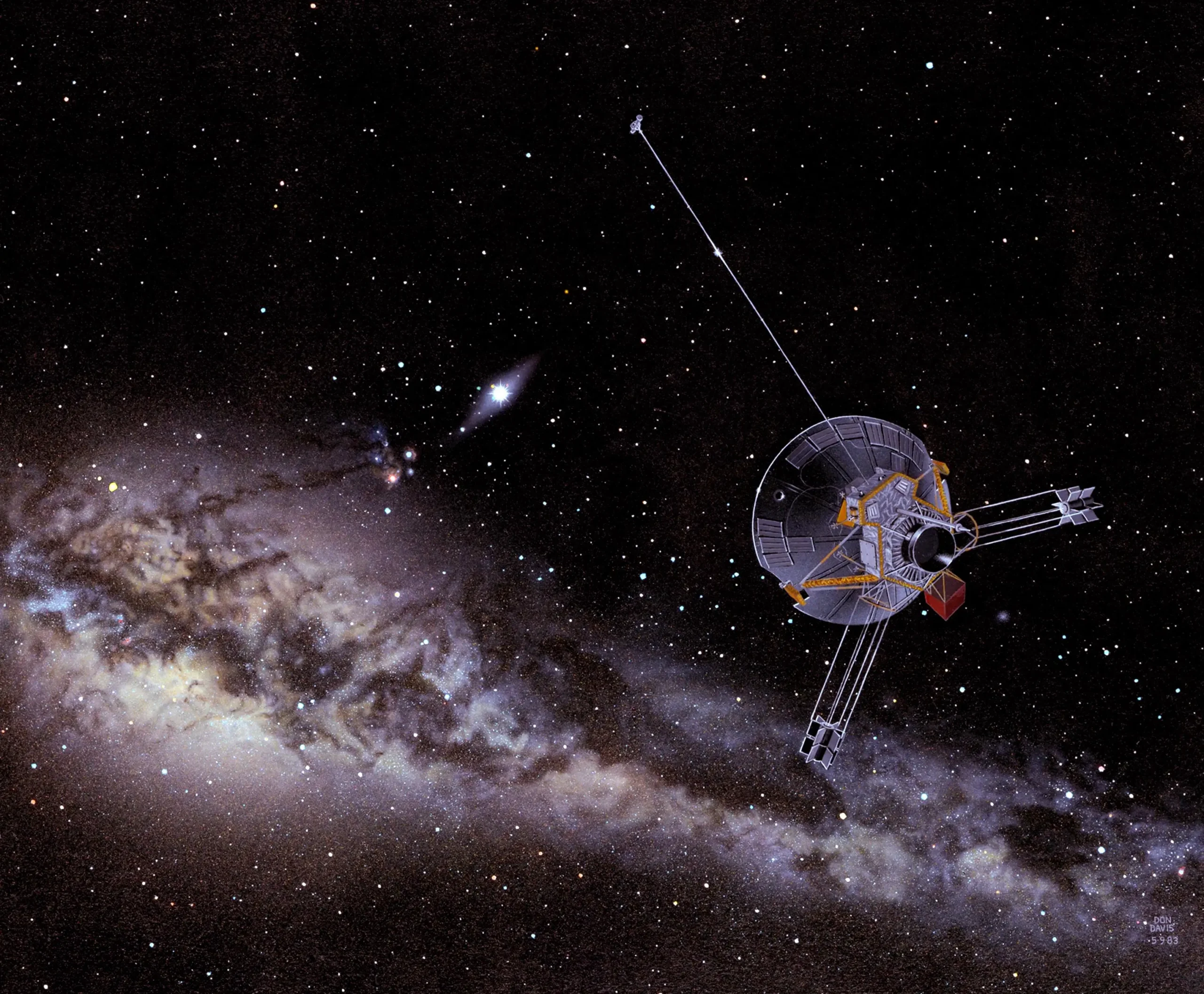
After nearly five decades of journeying through the cosmos, humanity’s most distant ambassador is running on fumes. NASA’s Voyager 1 spacecraft has just shut down yet another of its scientific instruments, a necessary sacrifice to keep the iconic probe alive a little longer. But engineers aren’t giving up just yet. They’re preparing for a bold, high-stakes maneuver called the “Big Bang” that could breathe new life into both Voyager missions.
Voyager 1 Loses Another Instrument in the Fight to Stay Alive
On April 17, mission controllers sent a command traveling across 15 billion miles of space to switch off the Low-Energy Charged Particle experiment, better known as the LECP. For 49 years, this remarkable instrument had been quietly studying ions, electrons, and cosmic rays in the spacecraft’s surroundings, contributing to our understanding of deep space in ways no other probe ever had.
The decision wasn’t made lightly. Voyager 1 is running dangerously low on nuclear power, and a routine roll maneuver conducted on February 27 caused an unexpected drop in available energy. With reserves dwindling, the mission team had no choice but to start making tough calls.
A Journey That Began in 1977 and Never Really Ended
It’s hard to overstate just how extraordinary the Voyager mission has been. When Voyager 1 launched in 1977, its original purpose was relatively modest by today’s standards: fly past Jupiter and Saturn, snap some pictures, gather data, and call it a day.
But the spacecraft kept going. And going. And going.
Its mission was extended time and time again until, in 2012, Voyager 1 became the first human-made object to officially cross into interstellar space. That historic milestone cemented its place as the most distant spacecraft ever built. Its twin, Voyager 2, followed the same path roughly six years later after its own grand tour that included Uranus and Neptune.
Both probes are still transmitting data back to Earth from the vast darkness beyond our solar system. That alone is an engineering miracle.
Why the Voyager Spacecraft Are Running Out of Power
The Voyager probes draw their energy from radioisotope thermoelectric generators, which convert heat from decaying plutonium into electricity. It’s reliable technology, but it has a built-in expiration date. Each year, the spacecraft lose approximately 4 watts of power, and nearly 50 years of steady decline have left them with razor-thin margins.
According to NASA’s Jet Propulsion Laboratory, which oversees the mission, the team has been forced to shut off heaters and instruments one by one. The tricky part is finding the balance between conserving power and keeping the probes warm enough that their fuel lines don’t freeze solid in the brutal cold of interstellar space.
After this most recent shutdown, the state of the mission looks like this:
- Voyager 1 has only two of its original ten science instruments still running
- Voyager 2 is operating three of its instruments
- The functioning instruments continue to study magnetic fields, plasma waves, and the boundary known as the heliopause
These remaining tools are still providing valuable information about conditions beyond our solar system, including the mysterious region where the solar wind collides with the interstellar medium.
The “Big Bang” Maneuver Could Rescue Both Voyager Missions
Without intervention, the latest shutdown only buys Voyager 1 about another year of operational life. That’s where the Big Bang comes in.
Despite its dramatic name, this isn’t some explosive event. It’s a carefully planned procedure where engineers swap out several powered components all at once, turning off certain systems while activating lower-power alternatives. The goal is to maintain enough warmth and energy to keep collecting scientific data while stretching the spacecraft’s remaining power reserves as far as possible.
JPL representatives explained that the approach involves replacing higher-drain devices with more efficient ones in a single coordinated sequence, hence the nickname.
If the plan succeeds, there’s even a chance the LECP instrument could be powered back on. That’s why engineers made the interesting decision to leave a tiny half-watt motor running on the instrument for now. It’s a small insurance policy, just in case they can resurrect it later.
Voyager 2 Will Test the Risky Procedure First
Because the Big Bang maneuver is complex and carries real risk, the mission team isn’t planning to try it on Voyager 1 right away. Instead, JPL will run initial tests on Voyager 2 throughout May and June.
There are good reasons for this cautious approach:
- Voyager 2 has slightly more power available than its twin
- It’s marginally closer to Earth, making communication a bit faster
- Any mistakes can be diagnosed and corrected more easily
Assuming those tests go smoothly, engineers plan to attempt the more delicate Voyager 1 version of the procedure no earlier than July.
Communicating Across 15 Billion Miles Is No Small Feat
One of the most mind-bending aspects of the Voyager mission is the sheer distance involved. Voyager 1 is currently about 15 billion miles from Earth, which translates to roughly 25 billion kilometers. That’s so far away that radio signals, traveling at the speed of light, take about 23 hours to reach the spacecraft.
When JPL sent the command to shut down the LECP, the actual process took a little over three hours once the signal arrived. Turning instruments back on is a different challenge entirely, especially considering the extreme cold and the enormous distance involved. There’s no room for error when every command takes nearly a full day to reach its destination.
What This Means for the Future of the Voyager Mission
The Voyager spacecraft represent one of humanity’s greatest scientific achievements. They’ve outlived their original missions many times over, delivered stunning discoveries about the outer planets, and ventured into territory no human-made object had ever explored. Their continued operation nearly half a century after launch is a tribute to the engineers and scientists who built and maintain them.
But the laws of physics are unforgiving. Nuclear decay will continue, power will keep dropping, and eventually the probes will fall silent forever. The Big Bang maneuver is essentially a clever attempt to buy more time for continued science before that inevitable day arrives.
Why the Voyager Probes Still Matter
Even with most of their instruments offline, the Voyagers continue to provide data that can’t be gathered any other way. They’re the only spacecraft actively studying the conditions of interstellar space firsthand. Every additional month of operation adds to humanity’s understanding of the environment beyond our solar system.
The Emotional Weight of the Mission
There’s something genuinely moving about this story. Two spacecraft launched during the disco era are still quietly working, still phoning home, and still contributing to science nearly 50 years later. The engineers at JPL are essentially performing long-distance surgery on machines older than many of them, trying to squeeze every last moment of usefulness from hardware that was never designed to last this long.
Looking Ahead to the Voyager Big Bang Maneuver
All eyes will be on JPL throughout the summer as the Big Bang procedure unfolds. First the tests on Voyager 2, then potentially the critical Voyager 1 attempt in July or later. Success could extend the mission by years. Failure could end it sooner than anyone hopes.
Either way, the Voyager story remains one of the most remarkable chapters in the history of space exploration, a testament to what humans can accomplish when vision, engineering, and a bit of stubborn optimism come together.