



















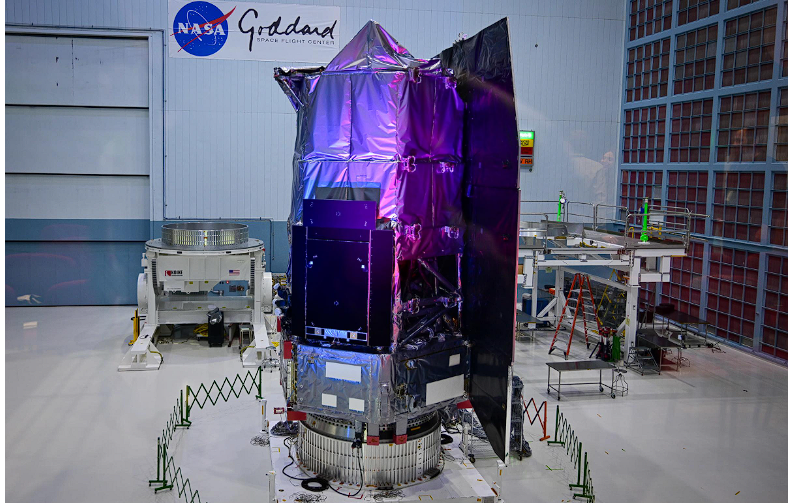
NASA is gearing up to send another groundbreaking observatory into space, and this one promises to change how we see the universe. The Nancy Grace Roman Space Telescope, affectionately known as Roman, is on track for an early September launch. With a field of view one hundred times larger than the legendary Hubble, it’s poised to open up vast new stretches of the cosmos for scientific exploration.
Roman Space Telescope Launch Set for September 2025
According to NASA, early September represents the earliest possible launch window for the Roman Space Telescope. If delays occur, the mission won’t slip beyond May 2027. The telescope will ride into space aboard a SpaceX Falcon Heavy rocket, one of the most powerful launch vehicles currently in operation.
This mission has been a long time coming. First introduced in 2016, the project was originally called the Wide Field Infrared Survey Telescope, or WFIRST. It was later renamed in honor of Nancy Grace Roman, who served as NASA’s first chief astronomer and is widely regarded as the mother of Hubble for her foundational role in bringing that iconic telescope to life.
Why Roman’s Enormous Field of View Is a Game Changer
Here’s what makes Roman so exciting. While its primary mirror is roughly the same size as Hubble’s, its field of view is in a completely different league. Roman can capture sections of the sky at least 100 times larger than Hubble in a single observation.
Think of it this way. Hubble is like looking at the night sky through a powerful telephoto lens, great for zooming in on specific objects with incredible detail. Roman, on the other hand, is like stepping back and taking a wide-angle shot that captures everything at once without sacrificing clarity.
This wide view will dramatically change how astronomers conduct their research. Julie McEnery, Roman’s senior project scientist, explained that the telescope will complement NASA’s other major observatories like the James Webb Space Telescope and the Chandra X-ray Observatory. Those instruments excel at studying specific objects in detail, but they rarely discover new ones. Roman’s sweeping view is expected to uncover countless previously unknown objects, and possibly even entirely new categories of cosmic phenomena that scientists haven’t imagined yet.
Where Roman Will Go and What It Will See
Once it escapes Earth’s atmosphere, Roman will travel to a special vantage point nearly one million miles away from our planet. This location, far from the interference of Earth’s heat and light, offers an ideal environment for deep space observation.
The telescope is equipped with two main instruments that will do the heavy lifting:
- A massive 300.8-megapixel camera capable of capturing light across visible and near-infrared wavelengths
- A high-contrast coronagraph designed to block out starlight so the telescope can observe exoplanets that would otherwise be hidden
The coronagraph is particularly exciting. Exoplanets, planets orbiting stars beyond our solar system, are notoriously difficult to see because their host stars are overwhelmingly brighter. By blocking that blinding starlight, Roman will give astronomers a much clearer look at these distant worlds.
Roman’s Mission: Tackling Some of the Biggest Questions in Astronomy
NASA has outlined an ambitious scientific agenda for the Roman Space Telescope. Its mission focuses on three major areas:
- Dark energy and its mysterious role in the universe
- Exoplanets orbiting distant stars
- Broader questions in astrophysics
The Dark Energy Puzzle
Dark energy is one of the most baffling topics in modern science. Despite decades of research, astronomers still know remarkably little about it. What’s truly mind-blowing is that dark energy is believed to make up roughly 68 percent of everything in the universe. That’s right, more than two-thirds of the cosmos is made up of something we barely understand.
Roman’s wide field of view and powerful imaging capabilities will allow scientists to survey enormous portions of the sky, tracking how galaxies move and cluster over cosmic time. This data could provide critical clues about what dark energy actually is and how it drives the accelerating expansion of the universe.
Hunting for New Worlds
Beyond dark energy, Roman will also dramatically expand our catalog of exoplanets. By scanning huge swaths of the Milky Way, the telescope is expected to detect thousands of new planets, including worlds similar in size to Earth orbiting in zones where liquid water, and potentially life, could exist.
Discovering the Unexpected
Perhaps the most thrilling aspect of Roman’s mission is the unknown. Whenever astronomers build a new instrument with unprecedented capabilities, they tend to stumble upon things no one predicted. Since no observatory like Roman has ever scanned the cosmos before, scientists anticipate it will reveal entirely new classes of objects and events.
How Roman Fits Into NASA’s Telescope Lineup
NASA now has an impressive collection of space-based observatories, and each plays a distinct role. Understanding how they work together helps explain why Roman is such a valuable addition.
Hubble Space Telescope
Launched in 1990, Hubble has been the workhorse of space astronomy for more than three decades. It captures detailed images across visible, ultraviolet, and near-infrared light and remains one of the most productive scientific instruments ever built.
James Webb Space Telescope
Webb, which launched in late 2021, specializes in infrared observations and has been peering into the earliest moments of the universe since its deployment. It excels at studying specific targets in incredible detail.
Chandra X-ray Observatory
Chandra focuses on X-ray emissions from some of the hottest and most energetic phenomena in the universe, including black holes and exploding stars.
Roman Space Telescope
Roman will serve as the wide-angle scout, surveying vast areas of the sky and identifying interesting targets that Webb, Chandra, and other instruments can then examine more closely. This complementary approach will make the entire fleet more effective than any single telescope could be on its own.
Beautiful Images Are Coming Too
While the scientific goals of the Roman Space Telescope are genuinely thrilling, there’s something more universally appealing to look forward to as well. Roman is almost certain to send back stunning, awe-inspiring images of the cosmos. If Hubble and Webb have taught us anything, it’s that space telescopes don’t just advance science, they also produce breathtaking art that connects millions of people to the wonders of the universe.
What to Expect in the Months Ahead
As the September launch window approaches, NASA will continue final preparations, testing, and integration work. Here’s what Roman’s journey will look like:
- Final ground testing and preparation leading up to launch
- Liftoff aboard a SpaceX Falcon Heavy rocket from Earth
- A months-long journey to its observation point nearly one million miles away
- A commissioning phase where instruments are calibrated and tested in space
- The beginning of scientific operations, followed by the first data release
Each of these steps will be watched closely by astronomers around the world, many of whom have spent years preparing research proposals that depend on Roman’s capabilities.
A New Era of Cosmic Discovery
The Nancy Grace Roman Space Telescope represents more than just another piece of hardware in orbit. It’s a tribute to a pioneering woman whose work made Hubble possible, and it’s a leap forward in our ability to understand the universe we call home. With its enormous field of view, powerful instruments, and ambitious mission goals, Roman has the potential to reshape modern astronomy.
From unraveling the mysteries of dark energy to discovering new planets and perhaps even phenomena we’ve never imagined, the next few years could bring some of the most exciting scientific breakthroughs in decades. And when those first dazzling images start beaming back to Earth, we’ll all have front-row seats to a whole new view of the cosmos.