

















Witkoff and Kushner Head to Pakistan for Second Round of Iran Peace Talks as Tensions Rise
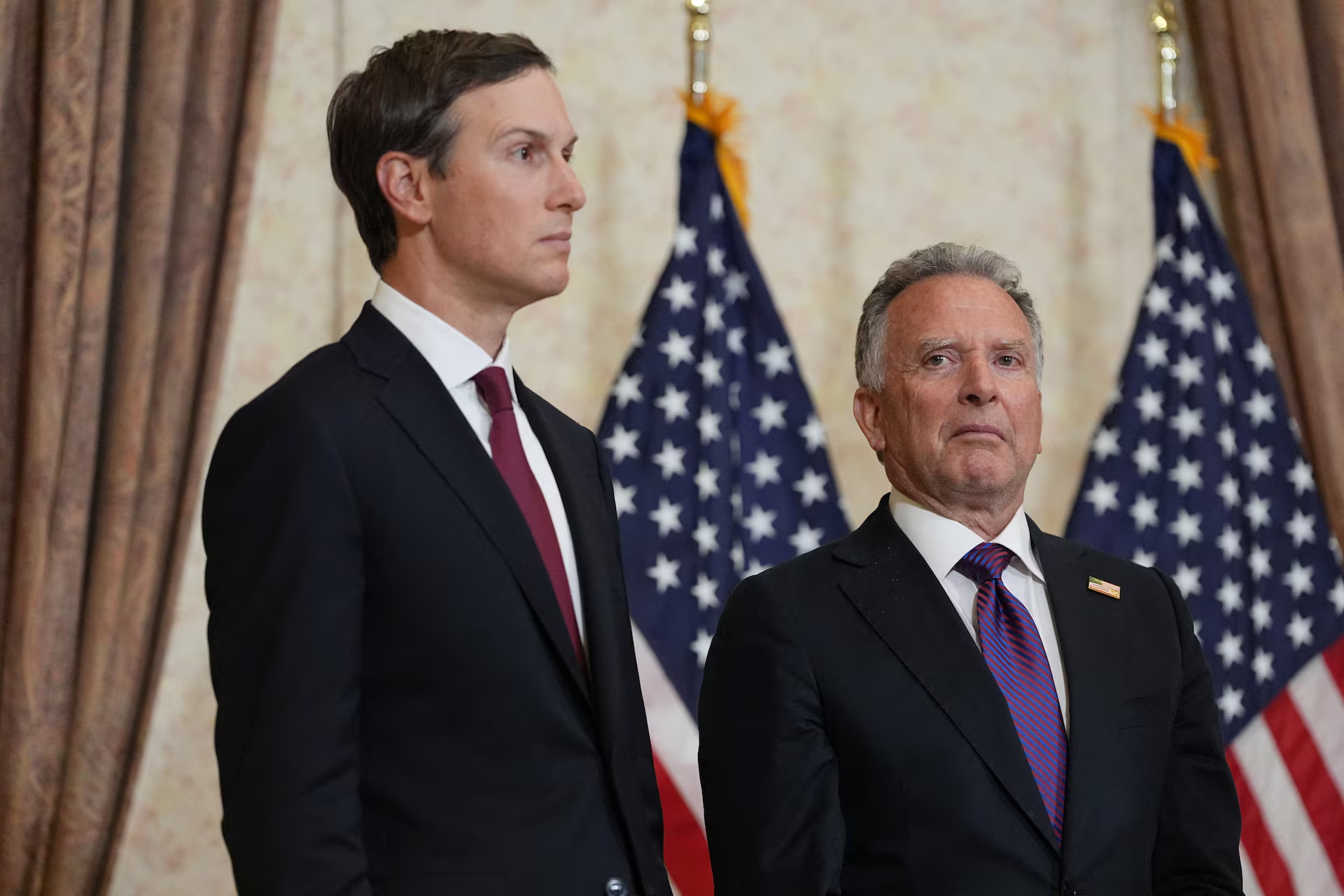
The Iran peace talks in Pakistan have entered a pivotal new phase. On Friday, the White House confirmed that Special Envoy Steve Witkoff and Jared Kushner are traveling to Islamabad for what is being described as a second round of negotiations aimed at calming the ongoing war between the United States and Iran. With Iran’s foreign minister already on the ground in Pakistan’s capital, the diplomatic spotlight has firmly turned toward South Asia.
The renewed effort comes at a time when the conflict continues to send shockwaves across the Middle East, with fresh airstrikes in Lebanon, a rejected ceasefire extension by Hezbollah, and stern warnings from Washington about the consequences of inaction. The next few days could prove decisive in shaping how this conflict moves forward.
A High Stakes Meeting in Islamabad
According to the White House, the United States is prepared to listen to a peace proposal from Iranian officials, with Pakistani intermediaries playing the role of trusted middlemen. The arrival of Iran’s foreign minister in Islamabad on Friday set the stage, and the expected arrival of Witkoff and Kushner adds significant weight to the talks.
Witkoff has been one of President Trump’s most trusted special envoys for some of the most sensitive global negotiations, while Kushner brings extensive experience from his earlier diplomatic work across the Middle East. The fact that both are being sent together signals that the United States is treating this round of talks with the highest level of seriousness.
Pakistan, for its part, has stepped into a major role as a mediator. With its longstanding diplomatic ties to Iran and a working relationship with Washington, the country is uniquely positioned to broker conversations that might otherwise be impossible to hold directly.
Why Pakistan Matters in This Moment
Pakistan’s involvement is more than symbolic. Islamabad has historically maintained delicate balances between competing global powers, and its geographical proximity to Iran makes it a logical hub for sensitive negotiations. By hosting both sides under one diplomatic roof, Pakistan offers a neutral space where ideas can be exchanged without the political optics of a direct meeting between American and Iranian officials.
This is significant because direct talks between the two sides have remained politically difficult. Pakistani intermediaries can carry messages, suggest compromises, and help filter out the noise so that the substance of any potential deal can take center stage.
Hezbollah Pushes Back on Ceasefire Extension
Even as diplomacy moves forward in Pakistan, the situation on the ground continues to deteriorate in other parts of the region. Israel launched fresh airstrikes in Lebanon, intensifying an already volatile situation. The strikes came shortly after President Trump announced a three-week extension of the Israel-Lebanon ceasefire.
That extension, however, has not been welcomed by all parties. A prominent Hezbollah lawmaker publicly stated that the Iranian-backed group firmly rejects the extension. The rejection complicates an already fragile situation and raises the possibility of renewed open conflict between Israel and Hezbollah forces in southern Lebanon.
This rejection also sends a message to Tehran’s negotiating partners. Hezbollah, often seen as an extension of Iran’s regional influence, taking a hard line could either strengthen Iran’s leverage at the negotiating table or undermine the talks entirely depending on how it is interpreted by American and Pakistani officials.
A Strong Warning From the Pentagon
Defense Secretary Pete Hegseth made it clear that the United States is not going to soften its stance just because diplomacy is underway. In recent remarks, Hegseth said that Iran still has time to choose wisely, but he made the consequences of refusing a deal extremely clear.
According to Hegseth, if Tehran does not reach an agreement with the United States, its economy will collapse under what he described as the unrelenting pressure of a US naval blockade. He emphasized that the blockade is not a temporary measure and will remain in place for as long as it takes.
This dual message of diplomatic openness paired with military and economic pressure has become a hallmark of the current US strategy. Washington appears to be sending a clear signal that it would prefer a peaceful resolution but is fully prepared to maintain its hardline posture indefinitely if necessary.
The Broader Stakes
The Iran peace talks in Pakistan are unfolding against a backdrop of multiple crises. Some of the most pressing issues include:
- Continued military tensions across the Middle East, including in Lebanon and Gaza
- Disruptions to global oil and gas markets driven by the conflict
- Concerns over the security of the Strait of Hormuz, a vital shipping route
- The risk of regional spillover involving countries like Iraq and Kuwait
- Mounting humanitarian concerns in conflict zones
Each of these issues adds urgency to the talks. A breakthrough in Islamabad could ripple outward and bring relief to multiple flashpoints. A breakdown, on the other hand, could push the entire region into deeper instability.
The Tug Between Diplomacy and Pressure
Observers have noted that the United States is essentially playing two cards at the same time. On one hand, it is sending senior officials to engage in talks. On the other, it is keeping a powerful naval presence in the region, including three aircraft carriers, and maintaining sweeping economic sanctions.
This combination is designed to create maximum pressure while leaving the door open for negotiation. The hope is that Iran will see the costs of continued resistance as too high and choose to engage seriously. Whether that calculation works depends on factors that go well beyond what happens at any single negotiating table.
What Iran Wants
While the public details of Iran’s position remain limited, analysts believe Tehran is likely seeking relief from sanctions, recognition of its regional interests, and some form of guarantee against further military escalation. The Iranian leadership is also under significant domestic pressure as economic conditions worsen for ordinary citizens.
Coming to the talks in Islamabad with a serious proposal could give Iran a way out of the current bind without losing face. However, anything that looks like surrender would be politically dangerous for Iranian leaders. This is why the role of mediators like Pakistan becomes so important. They can help craft language and frameworks that both sides can accept publicly.
What the United States Wants
Washington’s priorities have been more openly stated. The United States wants Iran to abandon its pursuit of nuclear weapons in a way that can be verified. It wants Iran to scale back support for proxy groups across the region, including Hezbollah. And it wants to ensure the free flow of energy through critical maritime routes like the Strait of Hormuz.
In exchange, the United States may be willing to ease some economic pressure and consider phased steps toward normalizing relations. But none of this is on the table without significant concessions from Tehran first.
Why This Round Could Be Different
Several factors make this second round of talks potentially different from previous attempts. These include:
- The personal involvement of high-profile envoys like Witkoff and Kushner
- Pakistan’s emerging role as a serious mediator
- The mounting economic toll on Iran from sanctions and blockade
- Growing fatigue across the region from prolonged conflict
- Increasing global pressure for energy market stability
None of these guarantee success, but together they create conditions that are at least more conducive to dialogue than what existed even a few weeks ago.
The Risk of Failure
If the talks collapse, the consequences could be severe. The US naval blockade would likely tighten, sanctions would expand further, and military tensions could escalate quickly. Hezbollah’s rejection of the ceasefire extension already shows how easily things can spiral. A failed round of talks could embolden hardliners on both sides and make future diplomacy even more difficult.
There is also the question of regional partners. Countries that have been quietly supporting diplomatic efforts could grow frustrated and shift their positions if no progress is made.
Final Thoughts
The Iran peace talks in Pakistan represent one of the most important diplomatic moments of the entire conflict. With Witkoff and Kushner heading to Islamabad and Iran’s foreign minister already in place, the stage is set for serious conversations. Pakistan’s role as mediator could prove transformative if the right balance can be struck.
At the same time, the warnings from the Pentagon and the latest events in Lebanon serve as a reminder that this is far from a simple negotiation. There are real military, economic, and political pressures driving every move on every side.
For now, the world watches and waits. A breakthrough could ease global tensions and bring desperately needed relief to civilians caught in the crossfire. A breakdown could deepen one of the most dangerous standoffs of the modern era. Either way, the days ahead will define not just the future of the Iran war, but the broader trajectory of stability in the Middle East and beyond.