

















The Flagellar Motor: How Bacteria’s Tiny Engine Reveals the Secret of Life Itself
The bacterial flagellar motor has fascinated scientists for more than half a century. It is a microscopic machine, almost unimaginably small, yet it operates with the efficiency and precision of an engineered electric motor. After decades of research, scientists have finally pieced together how this tiny biological engine works, and what they have discovered may be the closest thing biology has to a universal “life force.”
This story is not just about bacteria. It is about the hidden machinery that powers every living thing on Earth.
A Tiny Engine Built by Billions of Years of Evolution
Imagine being a single-celled organism, just a few microns across, floating in water that feels as thick as tar. You cannot move freely. Food may be far away, and you have no obvious way to reach it. Now imagine evolving, over a billion years, the perfect solution: a rotating tail powered by a molecular motor.
That solution is the bacterial flagellar motor. It is a self-assembling biological machine that spins a whip-like flagellum at hundreds of revolutions per second, pushing the cell forward at incredible speeds for its size. Some bacteria can swim more than ten times their body length in a single second.
What makes this engine so remarkable is not just its speed. It is the fact that nature engineered it long before humans even existed.
Why the Flagellar Motor Astonished Scientists
When the flagellar motor was discovered in the 1970s, biologists were stunned. Until then, the idea of a true rotating motor inside a living cell seemed impossible. Even creationists pointed to it as proof of “intelligent design,” claiming it was too complex to have evolved naturally.
Yet evolution did build it, step by step.
Aravinthan Samuel, a biophysicist at Harvard University, summed it up beautifully: biology can build wheels, and now we know how.
The discovery of the flagellar motor changed how scientists viewed biological complexity. It revealed that nature can engineer rotating machines without any guiding hand, simply through random mutations, natural selection, and time.
The Researcher Who Started It All
The journey to understanding this motor began with the late Howard Berg, a Harvard physicist who pioneered the study of bacterial movement. In the early 1970s, microscopes could not keep up with bacteria like E. coli, which would dart out of view almost instantly. To solve this, Berg invented an automatic tracking microscope that followed bacteria as they moved.
Through this innovation, he discovered that bacteria switch between two behaviors:
- Running, where they swim straight ahead
- Tumbling, where they reorient themselves randomly
Berg theorized that bacteria use these motions to follow chemical clues, swimming toward higher concentrations of nutrients and tumbling when food becomes scarce. He even proposed, before the technology existed to prove it, that the flagellum was rotating like a propeller.
He was right.
How the Motor Actually Works
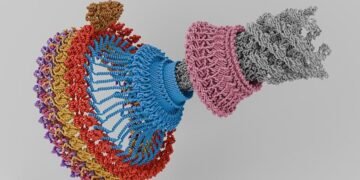
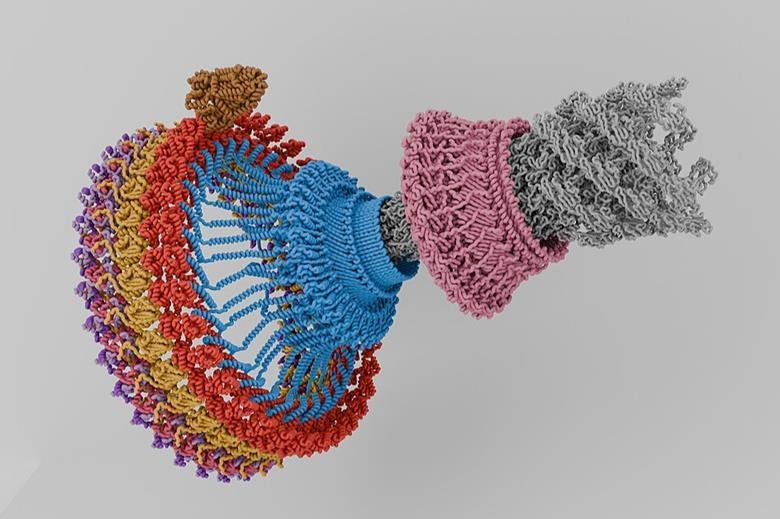
Thanks to advances in cryo-electron microscopy, also known as cryo-EM, scientists have finally been able to see the flagellar motor in stunning detail. The breakthrough came in waves of research between 2020 and 2026, with the final pieces falling into place earlier this year.
At the heart of the motor is the C ring, a ring of 34 identical proteins inside the cell membrane. When this ring spins, the flagellum spins with it.
But what powers the spinning?
The answer lies in tiny structures known as stators, smaller protein complexes that surround the C ring. Each stator forms a pentagonal ring with two central proteins inside. These pentagonal rings act like turnstiles, and what passes through them is something extraordinary: a steady stream of protons.
The Hidden Force of Life: The Proton Motive Force
Protons, the same particles found inside atoms, are the secret behind the motor’s energy. Bacteria, like nearly all living cells, maintain a steady flow of protons:
- Inside the cell, protons are scarce
- Outside the cell, they are abundant
- This imbalance creates a natural pressure that pushes protons back in
This phenomenon is known as the proton motive force, a concept first proposed in 1961 by Peter Mitchell, a biochemist working out of a private lab in Cornwall, England. His theory was initially mocked, but he later won the Nobel Prize in Chemistry in 1978 for his discovery.
Today, scientists understand that proton flow is not just an interesting curiosity. It is one of the foundational forces that powers life itself.
In the flagellar motor, every second, more than 2,000 protons pass through each pentagonal turnstile, gently pushing the structure clockwise and turning the C ring counterclockwise. This rotation is what propels the bacterium forward.
The Genius of Switching Directions
One of the most fascinating aspects of the flagellar motor is its ability to reverse direction. When environmental conditions worsen, bacteria need to tumble and reorient themselves. Here is how the switch happens:
- The cell modifies a protein called CheY, attaching a phosphorus atom to it.
- The modified CheY binds to one of the C ring proteins.
- This triggers a chain reaction, causing the entire C ring to “snap” into a new shape, similar to how a hair clip flips into another stable position.
- The motor then turns clockwise instead of counterclockwise.
- The flagellum bundle falls apart, and the cell tumbles.
Once conditions improve, the protein flips back, and the bacterium resumes swimming forward in a new direction. As Susan Lea of St. Jude Children’s Research Hospital explains, this is a remarkably elegant way of converting unidirectional energy into bidirectional motion.
Why This Discovery Matters Beyond Bacteria
The flagellar motor is not just a fascinating biological curiosity. It is a window into how all living cells operate. The proton motive force that drives the motor is the same force behind:
- Cellular respiration in humans
- Energy production in plants
- Nutrient transport across cell membranes
- The function of countless molecular machines
In other words, the same principle that allows a bacterium to swim toward food is the same principle that keeps every living thing on Earth alive. As Mike Manson, a longtime flagellar motor researcher, puts it, understanding the proton motive force is essentially understanding the foundation of all biology.
A 50-Year Mystery, Finally Solved
For scientists like Manson, who has spent his entire career studying the flagellar motor, the recent breakthroughs have been deeply emotional. He described finally understanding how this molecular machine works as the fulfillment of a lifelong quest.
Decades of imagination, theory, experimentation, and technological progress have come together to reveal one of nature’s most elegant inventions. And in doing so, scientists have not only solved a long-standing biological puzzle but also offered humanity a clearer view of what truly powers life.
The Beauty of Biology in Motion
The story of the bacterial flagellar motor is a reminder that some of the most powerful scientific discoveries come from the smallest of places. A creature too tiny to see with the naked eye holds within it a machine that has outperformed human engineering for billions of years.
It is a story of evolution’s quiet brilliance. It is a story of patient scientists piecing together one of biology’s greatest mysteries. And it is a story that suggests the true essence of life may not be found in something grand and abstract, but in something as simple, and as profound, as a stream of protons flowing through a microscopic motor.