



















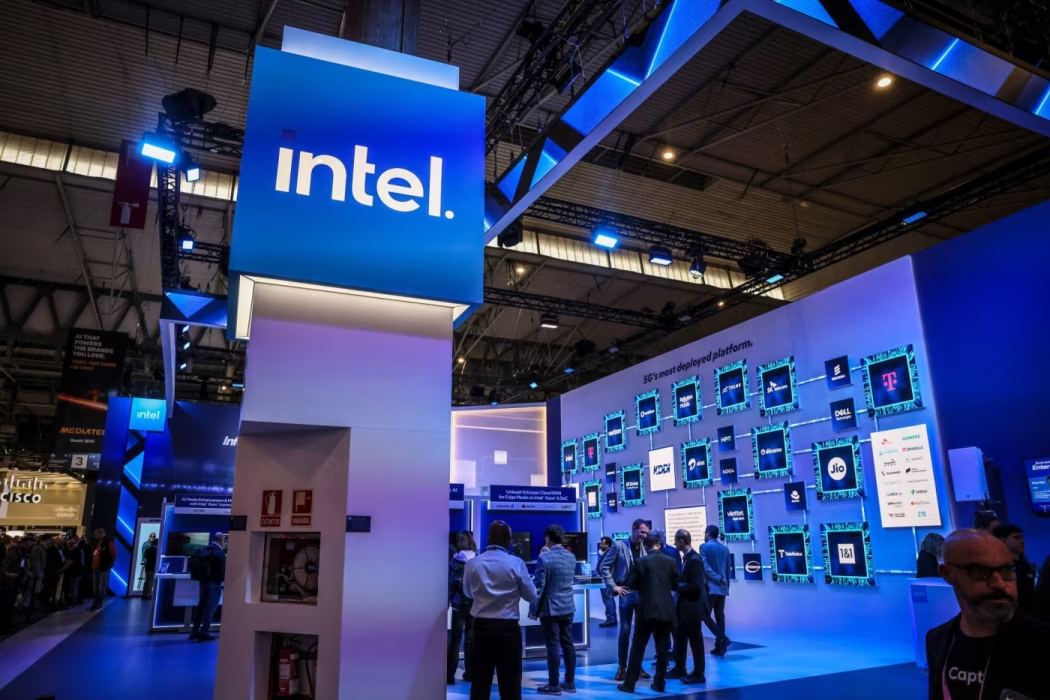
Intel Semiconductor Growth Story Echoes Nvidia’s Breakout Moment
The Intel semiconductor growth story is starting to look remarkably familiar to anyone who watched Nvidia’s incredible ascent unfold a couple of years ago. Last week’s standout earnings report from Intel carried the same kind of energy that defined Nvidia’s pivotal earnings announcement in 2023, when the chipmaker shocked the investing world by jumping 24 percent on enormous volume despite reporting year-over-year declines in both revenue and earnings.
That single Nvidia earnings event redefined how investors thought about growth in the semiconductor space, and Intel’s recent results suggest the playbook is repeating itself, this time across a different corner of the chip industry.
A Different Kind of Comeback
Intel is unlikely to morph into the next Nvidia in terms of sheer scale or AI dominance. But the market’s reaction to its latest results sends a clear signal that significantly higher prices may be in store, not just for Intel itself but for two other major players sharing the same semiconductor segment.
What makes this moment particularly intriguing is that the same forces driving Intel’s renewed momentum appear to be lifting other stocks in its corner of the industry, suggesting a broader trend rather than an isolated rebound.
Understanding the “E” in the PRIME Framework
For those unfamiliar with the PRIME framework for identifying potential growth stocks, the “E” stands for expectations of extraordinary growth, often described simply as the “growth story.” It’s a powerful concept because the right narrative can justify higher valuations and energize investor enthusiasm in ways that pure financial metrics sometimes cannot.
Nvidia’s growth story revolved entirely around its unique position in the rapidly expanding AI ecosystem. Intel, on the other hand, is now demonstrating that its own growth narrative can power not just its own stock but also those of competitors operating in the same niche.
A Closer Look at Nvidia’s Pivot
To understand why Intel’s story matters, it helps to revisit Nvidia’s transition. Throughout 2022, Nvidia struggled as cryptocurrency mining demand collapsed, dragging chip sales down. Then came a series of pivotal moments:
- OpenAI launched ChatGPT to the public on November 30, 2022.
- Anthropic introduced its competing AI, Claude, in March 2023.
- Google followed with Bard, which has since been rebranded as Gemini.
The explosion of large language models reshaped demand almost overnight. ChatGPT alone reached 100 million monthly active users by January 2023. Suddenly, the GPUs that crypto miners no longer needed were being snapped up by AI data centers.
Although year-over-year comparisons looked weak, sequential quarterly numbers were climbing rapidly. That sequential strength pushed Nvidia to repeated 52-week highs in the four quarters before its breakthrough earnings event. On May 24, 2023, the company guided to $11 billion for the upcoming quarter, projecting its biggest quarter ever and surpassing its previous record by a massive 33 percent.
Intel’s New Catalyst: A Leadership Change
Every dramatic turnaround needs a catalyst, and Intel’s came in the form of a new CEO. Lip-Bu Tan was announced as the company’s incoming chief on March 12, 2025, stepping in after years of frustrating performance under previous leadership.
The early reaction was enthusiastic but cautious. Despite an initial spike, the stock soon retreated to a 25-year low, and the first earnings report under the new leadership triggered an 8 percent drop. Skepticism remained high, and many investors weren’t yet convinced that real change was underway.
The Story Begins to Shift
Tan moved quickly to redirect the narrative. Instead of focusing on Intel’s expensive long-term manufacturing bets, he steered attention toward divisions that were already gaining traction, particularly chips designed for AI-driven data centers and so-called AI PCs poised to benefit from the next major upgrade cycle.
A high-profile agreement with the U.S. government added significant credibility to the new vision. The deal included a substantial equity stake and direct backing from President Trump, positioning Intel firmly at the heart of America’s semiconductor strategy. The dramatic stock surge that followed wasn’t the whole investment case, but it was a powerful indication that investors were buying into Tan’s revised story.
The Numbers Catch Up to the Narrative
The fundamentals have started telling their own compelling story. After five consecutive quarters of negative year-over-year EPS declines, Intel’s recent quarterly earnings reports have come in at +150 percent, +15 percent, and most recently +123 percent. Looking ahead, estimates for the next two quarters stand at 304 percent and 14 percent growth, and many analysts believe these figures could be revised even higher.
This dramatic shift aligns with the new emphasis on AI infrastructure and rising data center demand. Intel’s growth is being driven by surging interest in CPUs, traditional semiconductors that have become unexpectedly important to AI agent applications, which represent one of the fastest-growing segments in the AI space.
Industry forecasts project CPU demand to grow at 5 to 7 percent annually over the next decade as these chips become increasingly central to AI data center operations.
The Ripple Effect: AMD and ARM
This isn’t just an Intel story. The same trends benefiting Intel are creating tailwinds for AMD and ARM, both of which also produce CPUs. Following Intel’s strong report, both stocks responded with positive price action, suggesting that investors are recognizing the broader opportunity at play.
When multiple stocks within the same industry confirm a growth narrative, that’s a particularly powerful signal. It indicates that the trend isn’t simply company-specific hype but rather a structural shift creating opportunities across an entire segment.
Recognizing a Growth Story Doesn’t Require a PhD
You don’t need years of analytical training to spot the makings of a strong growth story. When a major company brings in a new leader, particularly during a turbulent period, that alone is a moment worth tracking. It’s essentially a signal that says, “Watch this one. The story might change.”
In Intel’s case, the change came faster than many expected, and the combination of new leadership, government backing, and AI-driven demand created a multi-layered case for renewed optimism.
Where the Market Stands
The broader market backdrop adds context to Intel’s emerging story. Tech leadership is once again pushing major indexes like the QQQ to new highs, supported by strong volume and broadly bullish breadth. However, beneath the surface strength, conditions appear slightly overbought, momentum is uneven across different indexes and styles, and cross-asset indecision in rates, commodities, and global markets suggests a more fragile underlying environment.
Still, when a clearly defined growth story aligns with strong technical conditions, the wind tends to stay at investors’ backs for an extended period. For Intel, AMD, and ARM, that wind appears to be picking up just as the AI revolution enters its next major phase.
The Bottom Line
The Intel semiconductor growth story represents one of those rare moments when a leadership change, government partnerships, and a powerful industry trend converge to create genuine opportunity. While Intel may not become the next Nvidia, the recent earnings results suggest that the entire CPU segment of the chip industry could be entering a multi-year growth phase that benefits all the major players.
For investors, the lesson is straightforward: when the growth story aligns with both fundamentals and broader sector confirmation, it’s worth paying close attention. That moment may have just arrived for Intel and its peers.
Disclaimer: This article is intended for informational purposes only and should not be considered as financial advice. Investments in the stock market involve risk, and readers are encouraged to consult a qualified financial advisor before making investment decisions.