



















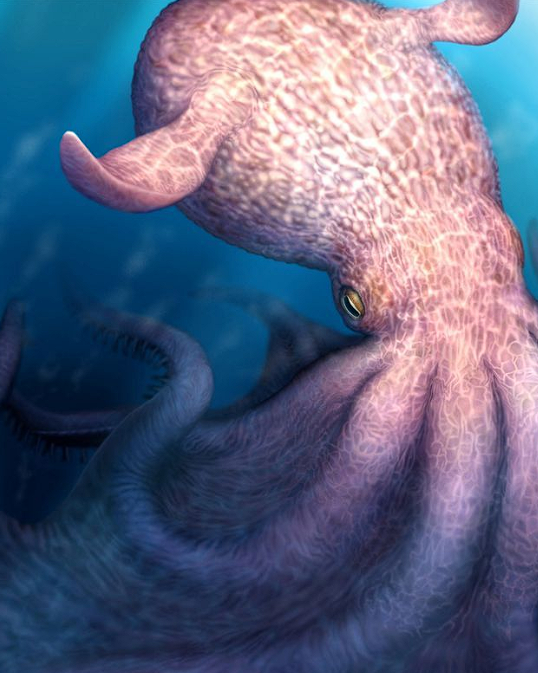
Cretaceous Kraken Octopus Discovery Reveals a Real-Life Sea Monster From the Age of Dinosaurs
The Cretaceous Kraken octopus discovery is rewriting what we know about life in the ancient oceans, and the findings sound straight out of a mythological tale. While dinosaurs ruled the land during the Cretaceous Period, a massive tentacled predator was patrolling the seas, hunting prey with powerful jaws and incredible intelligence. New research has identified an octopus species so enormous and formidable that scientists are calling it a real-life Kraken, the legendary sea monster from Norse folklore.
This breakthrough study, led by paleontologists in Japan, fundamentally changes how we view prehistoric marine ecosystems. Forget the assumption that vertebrate predators alone dominated the ancient seas. There was another type of creature lurking in those waters, and it was every bit as terrifying as the marine reptiles and giant sharks of its time.
Meet Nanaimoteuthis Haggarti: The Real-Life Kraken
The newly studied creature has been named Nanaimoteuthis haggarti, and the numbers behind it are genuinely staggering. According to research published in the journal Science, this enormous octopus species lived approximately 86 to 72 million years ago and could grow anywhere from 22 to 61 feet in length.
To put that size into perspective, the largest known modern invertebrate is the giant squid, which reaches about 39 feet in total length. Nanaimoteuthis haggarti could potentially be more than 50% longer than today’s giant squid, making it one of the largest invertebrates ever documented in the fossil record.
Yasuhiro Iba, a paleontologist from Hokkaido University in Japan and lead author of the research, summed it up perfectly. According to him, these animals were remarkable creatures with large bodies, long arms, powerful jaws, and advanced behavior — essentially fitting the description of a real “Cretaceous Kraken.”
How Scientists Uncovered the Truth
You might be wondering how researchers managed to study a soft-bodied creature from millions of years ago. After all, octopuses don’t typically leave behind much in the way of fossils. Their bodies are mostly soft tissue that decomposes quickly without leaving lasting evidence.
The answer lies in one specific body part — the beak. Octopuses have hard, durable jaw structures made from a material called chitin, the same substance found in the exoskeletons of crabs, lobsters, and insects. Unlike soft tissue, chitin can survive the fossilization process, leaving behind a rigid record of these ancient creatures.
The research team studied numerous beak fossils discovered in Japan and Canada’s Vancouver Island. Some of these fossils had been previously known but were reexamined with fresh eyes, while others were newly discovered specimens. By analyzing the shape and size of the beaks and comparing them to modern octopus anatomy, scientists were able to estimate the overall body dimensions of these prehistoric giants.
A Predator Built for the Hunt
The Cretaceous Kraken wasn’t just big — it was a serious predator with all the tools necessary to dominate its environment. The wear patterns observed on the beaks tell a fascinating story about how these creatures hunted and what they ate.
Researchers found that the beaks showed intense wear consistent with repeatedly crushing hard structures like bones and shells. This pattern strongly suggests that Nanaimoteuthis haggarti hunted substantial prey, including large fish, shelled tentacled creatures (like ammonites), clams, and other sizable marine animals.
In the largest specimens, approximately 10% of the total jaw length appears to have been lost due to wear over the course of the animal’s life. According to Iba, this level of wear is significantly more severe than what’s typically seen in modern octopuses and cuttlefish that feed on hard prey. It speaks to a creature that spent its life crushing through tough exteriors to access the meat inside.
Did These Octopuses Have Fins?
One of the more intriguing aspects of the research relates to how these massive creatures actually moved through the water. The shape of the fossil beaks resembled those of certain deep-sea octopuses living today — specifically, species that swim using fins.
Based on this similarity, the researchers concluded that the Cretaceous octopuses likely had fins as well. This would have given them an additional method of propulsion beyond the jet propulsion that octopuses are typically known for, potentially making them more efficient and graceful predators in the water.
Imagine a 60-foot creature with massive arms, powerful jaws, and the ability to glide through the ocean using fins. It’s a vision that seems lifted from a horror movie, yet it’s apparently exactly what these creatures looked like.
A Smaller Cousin That Was Still Massive
Nanaimoteuthis haggarti wasn’t alone in its class. Researchers also studied a close relative called Nanaimoteuthis jeletzkyi, which lived a bit earlier (from about 100 to 72 million years ago) and was somewhat smaller — though “smaller” is relative here.
Nanaimoteuthis jeletzkyi ranged from 9 to 25 feet in length. While not quite as enormous as its larger cousin, this species was still a formidable predator and far larger than any octopus alive today. The fact that the Cretaceous seas hosted multiple species of giant predatory octopuses reinforces just how different ancient ocean ecosystems were from what we see today.
Intelligence and Behavior That Surprised Scientists
One of the most fascinating aspects of the research isn’t just about size — it’s about behavior. Modern octopuses are known for their remarkable intelligence, often regarded as among the smartest invertebrates on the planet. The fossil evidence suggests that Nanaimoteuthis haggarti shared this trait.
Iba pointed out that the fossils show asymmetric wear on the jaws, suggesting that these ancient octopuses exhibited lateralized behavior — meaning they favored one side over the other, similar to how humans have a dominant hand. This kind of “handedness” is associated with sophisticated cognitive abilities and complex behaviors.
This insight is genuinely groundbreaking. It implies that the Cretaceous Kraken wasn’t just a brute-force predator. It was an intelligent hunter capable of nuanced behaviors and possibly even strategic problem-solving when capturing and processing prey.
Sharing the Seas With Marine Reptiles and Mega Sharks
The Cretaceous oceans were home to some of the most spectacular and terrifying predators ever to exist. Mosasaurs and plesiosaurs — massive marine reptiles — could reach up to 50 feet in length. Sharks of the era rivaled the size of today’s great whites, and some species were significantly larger.
Now we know that Nanaimoteuthis haggarti shared these waters with all these creatures. Researchers believe these giant octopuses likely occupied the same ecological tier as the marine reptiles and sharks, potentially competing with them for prey and resources.
This raises fascinating questions about predator dynamics in the Cretaceous. Did these massive octopuses use stealth and intelligence to gain advantages over their faster, vertebrate competitors? Did they avoid certain areas where mosasaurs hunted, or did they confront them directly? The fossil record may eventually reveal more, but for now, scientists can only imagine the dramatic encounters that must have taken place beneath the waves.
Rewriting Our View of Ancient Oceans
For roughly the past 370 million years, marine ecosystems have been understood as being dominated by large vertebrate predators. The story typically goes from fish and sharks to marine reptiles to whales — a procession of bony or cartilaginous animals at the top of the food chain.
This new research challenges that narrative. According to Iba, the existence of these giant octopuses shows that invertebrates also functioned as apex predators in the Cretaceous sea. This is a significant shift in how we understand the structure of ancient marine ecosystems.
Instead of imagining oceans where vertebrate predators alone ruled, we now have to consider that giant invertebrates were also at the top of the food web. This more complex view of ancient oceans makes them feel even more alien and fascinating than we previously thought.
Why This Discovery Matters
The discovery of the Cretaceous Kraken has implications beyond just adding a cool creature to our prehistoric encyclopedia. It changes our fundamental understanding of how marine ecosystems work and have worked throughout history.
Some of the broader implications include:
- Reassessing the role of invertebrates in ancient ecosystems
- Understanding how soft-bodied creatures can dominate alongside vertebrate predators
- Recognizing that intelligence and behavioral complexity in cephalopods may be much older than previously thought
- Reconsidering competition dynamics in ancient seas
- Inspiring new approaches to studying poorly preserved soft-bodied animals from the fossil record
This last point is particularly important. The success of this research using just beak fossils demonstrates that there’s likely much more to learn about ancient soft-bodied creatures if scientists know where to look and what to study.
The Fascination With Sea Monsters
There’s something deeply compelling about the idea of a real-life Kraken. Sea monsters have captured human imagination for thousands of years, appearing in legends from cultures around the world. From Norse mythology to ancient Greek tales, the image of a tentacled beast emerging from the deep has remained a powerful symbol of the unknown.
The discovery of Nanaimoteuthis haggarti gives those legends a strange kind of validation. While the modern world doesn’t have actual Krakens, our planet did once host creatures that could have inspired such myths if humans had been around to witness them. The line between mythology and prehistoric reality has blurred in a fascinating way.
Comparing the Cretaceous Kraken to Modern Octopuses
Today’s octopuses, while remarkable in many ways, are dwarfed by their Cretaceous ancestors. The largest modern octopus species, the giant Pacific octopus, typically reaches around 16 feet in arm span and weighs about 110 pounds. Compare that to a creature that could be 61 feet long, and the difference is staggering.
What changed? Why don’t we have octopuses this size today? The answers likely involve a combination of factors including environmental changes, competition from other predators, evolutionary pressures, and changes in food availability. The mass extinction events that ended the Cretaceous Period also dramatically reshuffled marine ecosystems, opening some niches and closing others.
Final Thoughts
The Cretaceous Kraken octopus discovery represents one of those rare moments when paleontology delivers something truly extraordinary. A massive, intelligent, fin-equipped octopus that prowled ancient seas as an apex predator — it’s the kind of finding that captures the public imagination while also making serious scientific contributions to our understanding of evolution and ecology.
For science, this research opens new questions about how we’ve classified ancient marine ecosystems and reminds us that our picture of prehistoric life remains incomplete. There may well be other surprises waiting in the fossil record, particularly when it comes to soft-bodied creatures whose remains are easily missed.
For the rest of us, the discovery offers a thrilling glimpse into a world that no human has ever seen — one where giant octopuses lurked beneath the waves, hunting prey with intelligence and power, sharing the oceans with other monsters from the deep. The Cretaceous seas were truly a different world, and Nanaimoteuthis haggarti has just made them feel even more wonderfully strange.