


















NASA’s Nancy Grace Roman Space Telescope Set to Launch Eight Months Early and Under Budget
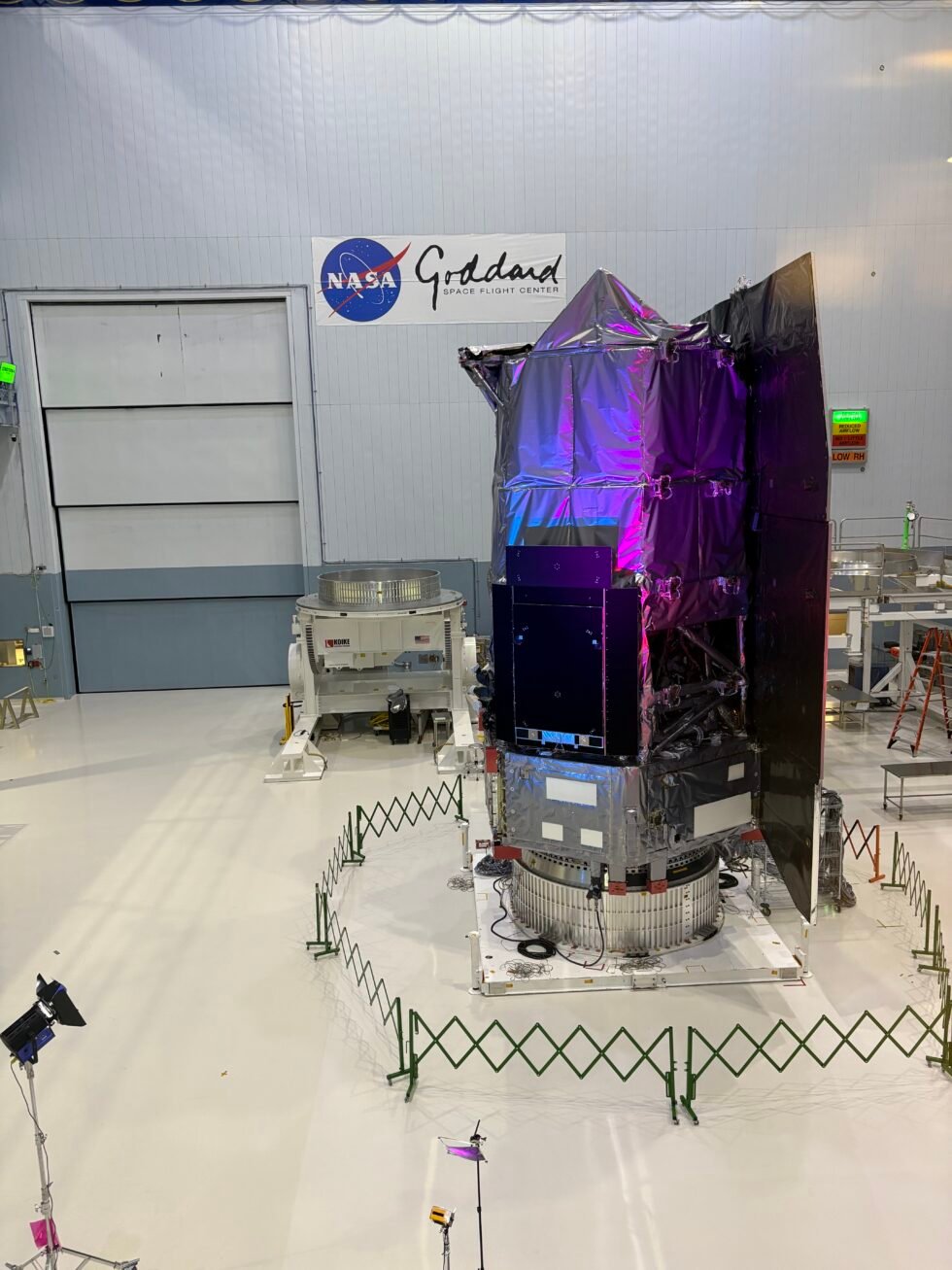
In a rare piece of feel-good news from the world of space exploration, NASA has announced that its long-awaited Nancy Grace Roman Space Telescope is ready to launch, and it’s doing so eight months ahead of schedule and under budget. Journalists were recently invited to NASA’s Goddard Space Flight Center in Greenbelt, Maryland, where the fully assembled telescope was revealed in all its impressive glory, waiting for its September liftoff.
The Roman Space Telescope, also known as NGRST, is named after the late Nancy Grace Roman, who played a key role in the planning of the Hubble Space Telescope. While it may sit in the same family of great observatories as Hubble and James Webb, the Roman Telescope has a very different purpose and an even more interesting origin story.
A Telescope With Massive Ambitions
Unlike Hubble, which captures ultra-sharp images of small patches of sky, or Webb, which peers deep into specific cosmic corners, the Roman Telescope is designed to look at huge sections of the sky at once. It’s a survey telescope, built around a wide-field view that can image portions of space roughly 100 times larger than the biggest images Hubble is capable of producing.
This kind of capability doesn’t come cheap when it comes to data. The Roman Telescope is expected to beam back around 1.4 terabytes of information to Earth every single day. That’s an enormous volume of astronomical data, but it’s what’s needed to keep up with the sheer scale of everything Roman will be watching.
An Unusual Origin: Spy Hardware Becomes a Scientific Tool
One of the most fascinating chapters in the Roman Telescope’s story has to do with how it came to be. Originally, NASA had planned a project called WFIRST, the Wide Field Infrared Survey Telescope, which was going to use a 1.5-meter telescope. That was until the National Reconnaissance Office decided that two of its spy satellites were surplus to requirements and offered the hardware to NASA.
As it turns out, the donated spy telescope hardware was nearly twice the size of what NASA had originally planned. NASA’s Mark Melton explained that the agency had to scale up a lot of the existing design to accommodate the bigger mirrors, but the upgrade paid off. The result was higher-resolution imaging and more space inside for advanced instruments.
The finished telescope is so large that it literally extends beyond the second story of the building it’s housed in. That’s not your average piece of scientific equipment.
Why Infrared Matters
One of the main reasons the Roman Telescope is so valuable is that it’s built for infrared astronomy. Many of the most important phenomena in the universe, including the earliest galaxies and the atmospheres of distant exoplanets, can only be observed at infrared wavelengths.
The problem is that Earth’s atmosphere absorbs a significant amount of infrared light, which makes ground-based infrared astronomy extremely difficult. This is why infrared space telescopes like Spitzer have been so important, and why Roman is now stepping up to take the baton with far greater capabilities.
The Two Key Instruments Aboard
Despite the telescope’s massive size and ambitious mission, it’s actually equipped with just two main scientific instruments. Each serves a very specific and important purpose.
The Wide Field Instrument is the star of the show when it comes to large-scale surveys. Its field of view is roughly the size of a full Moon in the night sky, which sounds modest until you compare it to Hubble’s much narrower view. The instrument uses an array of 18 individual detectors, each capable of capturing 4096 by 4096 pixels. The resulting survey images are so massive that NASA astronomer Julie McEnery estimated that displaying one at full single-pixel resolution on 4K displays would require enough TVs to cover the surface of El Capitan in Yosemite.
Between the mirrors and the detectors sits a rotating carousel of filters that controls which wavelengths of light reach the imaging sensors. The carousel also includes a prism and a grism, which allow the telescope to perform spectroscopy. This means Roman can analyze the specific wavelengths of light coming from celestial objects, revealing information about their composition, temperature, and distance.
The second instrument is the Coronagraph, a device that blocks out the light of a central star so that nearby objects can be directly imaged. It’s a complex and precise piece of engineering, and the one flying on Roman will be the first space-based coronagraph with active elements. These components can adjust in real time to suppress starlight even further, making it possible to directly image exoplanets that would otherwise be drowned out by their host stars.
Simpler Than Webb, and That’s a Good Thing
Compared to the James Webb Space Telescope, Roman is remarkably simple. Webb had to unfold like a cosmic origami sculpture after launch, a process filled with nail-biting moments for engineers. Roman, by contrast, has relatively few moving parts that need to be deployed once in space.
The main deployable components, like its solar arrays and high-gain antenna, are spring-loaded devices. Once the telescope releases the latches, they simply open into place. Mark Melton said this process begins as early as 20 minutes after the telescope separates from its launch vehicle.
Commissioning is expected to take just 90 days, and Melton noted that Roman could begin doing science before it even completes the final burn to reach its orbit at the L2 Lagrange point.
A Long Operational Life Ahead
Roman is being launched with enough fuel to maintain its orbit for at least 10 years, based on conservative estimates of fuel usage. In reality, the telescope is likely to operate well beyond that, barring any major hardware failures. Fuel will ultimately be the primary limit on its lifespan, not its scientific instruments or structure.
That’s a long runway for discovery, and given how much data Roman is expected to generate, scientists will have plenty of work to do throughout its mission.
What Roman Will Help Us Discover
Roman is being built with a specific set of scientific goals in mind, although its capabilities will almost certainly lead to discoveries no one has yet imagined. Here are the main targets the mission is set to investigate:
- Baryon acoustic oscillations: These are patterns frozen into the structure of the universe from its earliest days, and they can reveal important clues about dark matter and dark energy.
- The evolution of the universe: By mapping large-scale structures, Roman will help scientists understand how galaxies have evolved and how dark energy might be changing over time.
- Exoplanet imaging: Using the Coronagraph, Roman will directly image exoplanets in wide orbits around distant stars.
- Microlensing exoplanet surveys: Roman will repeatedly observe crowded regions of the galactic bulge to detect planets through gravitational microlensing, including “rogue planets” that float freely through space.
- Asteroid cataloging: Its wide-field capabilities make it ideal for finding and tracking asteroids near Earth.
The microlensing survey in particular is expected to identify tens of thousands of new exoplanets, many of them farther from their host stars than the ones identified by the Kepler mission. Roman will observe target regions at 15-minute intervals, capturing the brief brightening and dimming events caused by planets passing between their stars and Earth.
A Stepping Stone to Future Missions
The Coronagraph on Roman isn’t just a scientific instrument. It’s also a proving ground for future missions. Its technology will help inform the development of the Habitable Worlds Observatory, which will need to be 100 times more effective at blocking out starlight to directly image Earth-like exoplanets in the future.
In other words, Roman is helping pave the way for the next generation of planet-hunting technology.
The Lessons Learned
NASA Administrator Jared Isaacman emphasized that the Roman project has offered valuable lessons about how future missions might be managed. Finishing a telescope of this scale eight months ahead of schedule and under budget is a rare achievement in the world of space exploration, and NASA is clearly taking note of what went right.
Efficient planning, smart reuse of existing hardware, and a streamlined design all contributed to the project’s success. These are lessons that could benefit NASA’s ambitious plans for upcoming missions in the coming decades.
Why This Matters
Space telescopes like Hubble and Webb have already transformed how we understand the universe. Roman is poised to continue that legacy while filling in some of the gaps that no previous observatory has been able to address. Its ability to survey massive portions of the sky in detail means it can help answer some of the biggest questions in science, including the nature of dark matter and dark energy, the diversity of planetary systems, and the structure of the early universe.
For astronomers, Roman represents a massive new resource. For the general public, it represents the next great chapter in our ongoing journey to understand our place in the cosmos.
A Launch Worth Watching
With its September launch fast approaching, the Nancy Grace Roman Space Telescope is generating significant excitement across the scientific community. It won’t replace Hubble or Webb, but rather will complement them, adding a powerful new set of eyes to humanity’s view of the universe.
As Julie McEnery beautifully put it, the most exciting science from Roman is likely to come from the things we didn’t expect and couldn’t predict. Those surprises are what push science forward, raising new questions that future missions will then try to answer.
Final Thoughts
The story of the Nancy Grace Roman Space Telescope is one of ingenuity, collaboration, and quiet triumph. From its origins in surplus spy hardware to its ambitious scientific goals, the telescope represents the best of what space exploration can offer. And with its launch coming in September, ahead of schedule and under budget, it’s a rare reminder that big, complex projects can still succeed when the right people, tools, and planning come together.
Keep your eyes on the skies this fall. The Roman Telescope is about to begin its journey, and the discoveries that follow could reshape our understanding of the universe for generations to come.